


Why Arkansas Homes Are Especially Vulnerable to Storm Damage
How the Arkansas storm corridor creates unique roofing challenges comes down to one core fact: Arkansas sits at the intersection of Gulf moisture, cold continental air, and a geography that physically funnels and amplifies severe weather directly over populated areas — producing hail, high winds, and tornadoes far more often than most U.S. states.
Here’s a quick breakdown of why this region is so demanding on roofs:
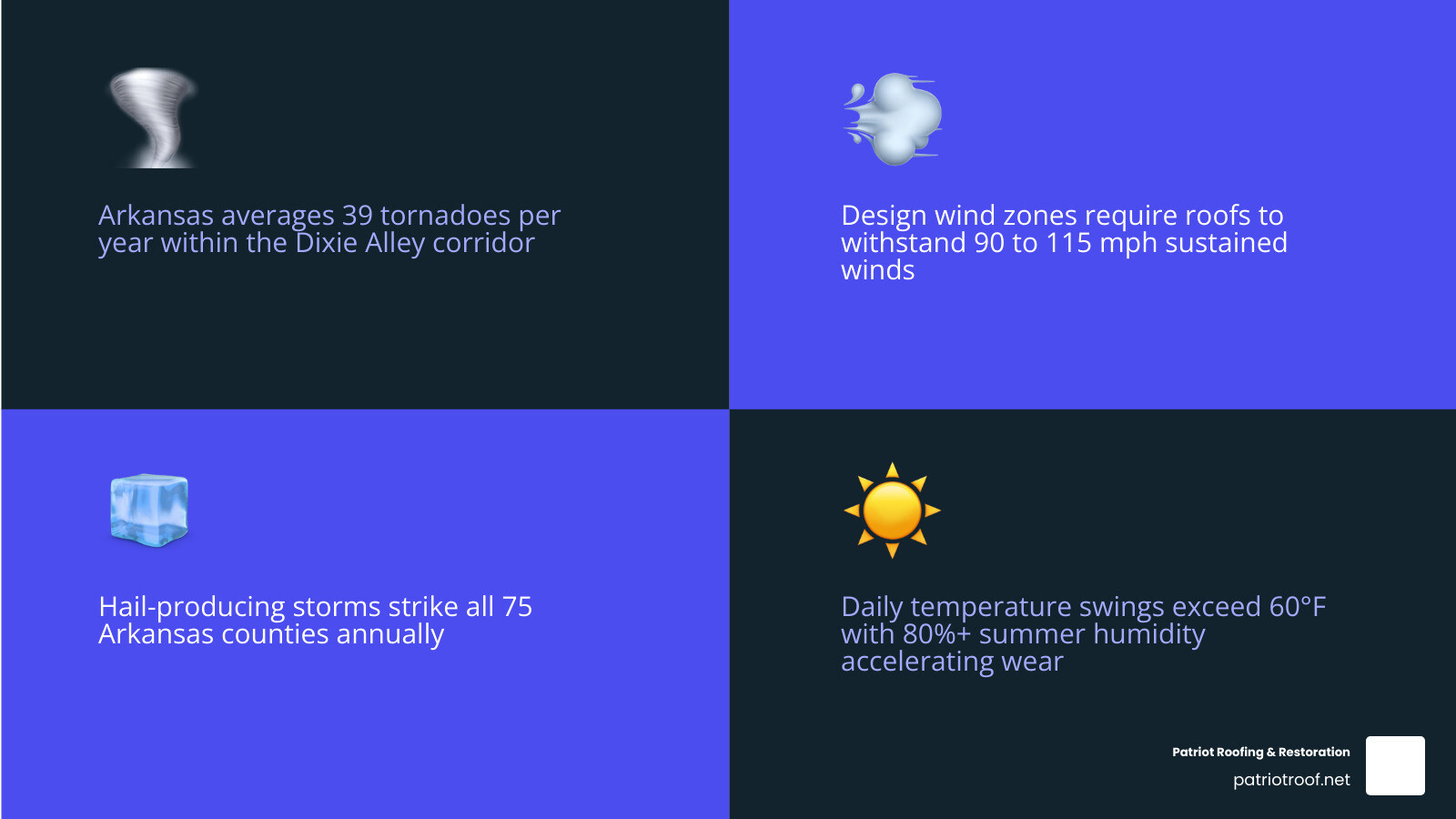
- Hail frequency: Severe hail-producing storms strike all 75 Arkansas counties, with a documented corridor running from Texarkana through Little Rock to Jonesboro
- Wind loads: Arkansas design wind speed zones require structures to withstand 90 to 115 mph sustained winds depending on location
- Tornado exposure: Arkansas averages roughly 37 tornadoes per year, based on the National Weather Service Little Rock thirty-year average for 1991 to 2020, placing it firmly within “Dixie Alley” — the southeastern extension of Tornado Alley
- Compounding stressors: Beyond storms, roofs face 60°F+ daily temperature swings, 80%+ summer humidity, and intense UV — all of which accelerate material breakdown between storm events
- Older roof vulnerability: Asphalt shingles lose adhesive strip integrity after roughly 15 years of thermal cycling, making aging roofs disproportionately susceptible when the next storm hits
The result is a roofing environment where standard materials and minimum-code installations quietly fail — often before homeowners realize anything is wrong.
This guide walks you through exactly how storm corridor conditions damage roofs, how to spot that damage, and what it takes to protect your home for the long term.
Related reading:
- Arkansas climate and your roof
- How Arkansas weather shortens roof lifespan compared to milder climates
- How ice storms in Arkansas winters damage roofs differently than summer storms
Understanding How the Arkansas Storm Corridor Creates Unique Roofing Challenges
To understand why our roofs take such a beating in Central Arkansas—from Little Rock and Conway down to Hot Springs—we have to look at the state’s unique physical geography. Arkansas acts as a giant meteorological funnel.
The state is sandwiched between the Ozark Plateau to the north and the Ouachita Mountains to the south. When warm, moisture-laden air surges northward from the Gulf of Mexico, it collides directly with cooler, denser continental air masses descending from the plains. The physical topography of the Arkansas River Valley channels this atmospheric clash, concentrating wind energy, heavy precipitation, and severe updrafts directly over our communities.
This atmospheric funneling doesn’t just breed dramatic spring supercells; it creates a relentless cycle of environmental stress. In places like Benton, Bryant, and Sherwood, roofs must contend with rapid, severe temperature swings. It is not uncommon to experience a 60°F temperature differential within a single 24-hour period.
These extreme shifts trigger severe thermal cycling. As the sun beats down on a hot summer afternoon, roofing materials expand. When a sudden storm front sweeps through, dropping cold rain and hail, the materials contract rapidly. Over time, this constant expanding and contracting fractures the asphalt binders in shingles, weakens sealant bonds, and causes protective granules to slough off.
For a detailed look at how these daily atmospheric battles shorten the life of your roof, check out our A Practical Guide to Arkansas Heat Humidity and Storms and read our AZ Guide to How Arkansas Weather Shortens Roof Lifespan.
The Triple Threat: Hail, Wind, and Tornado Damage Mechanics
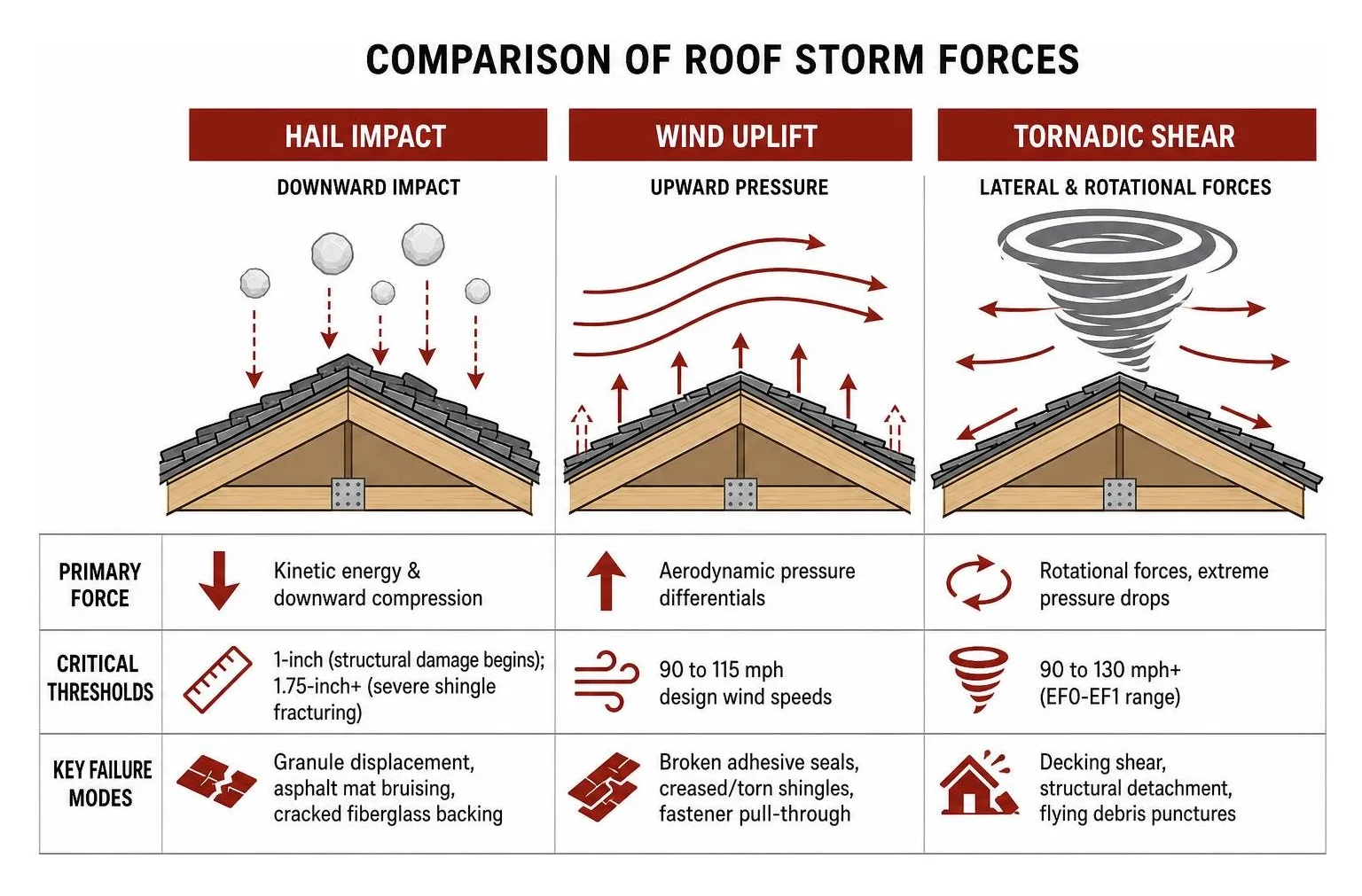
When severe weather strikes communities like Cabot, Maumelle, or Jacksonville, it rarely brings just one type of hazard. Instead, our roofs are subjected to a triple threat of distinct mechanical forces: hail impact, wind uplift, and tornadic shear.
Understanding the differences between these forces is critical for identifying damage before it leads to active leaks. To understand the primary differences in how these elements attack your home, explore our In-Depth Guide to Wind vs Hail Roof Damage and learn more about How Many Tornado Events Does Central Arkansas See Annually.
| Damage Type | Primary Force | Critical Thresholds | Key Failure Modes |
|---|---|---|---|
| Hail Impact | Kinetic energy & downward compression | 1-inch (structural damage begins); 1.75-inch+ (severe shingle fracturing) | Granule displacement, asphalt mat bruising, cracked fiberglass backing |
| Wind Uplift | Aerodynamic pressure differentials | 90 to 115 mph design wind speeds | Broken adhesive seals, creased/torn shingles, fastener pull-through |
| Tornadic Shear | Rotational forces, extreme pressure drops | 90 to 130 mph+ (EF0-EF1 range) | Decking shear, structural detachment, flying debris punctures |
Hail Impact Mechanics and Shingle Bruising
When hail falls in Central Arkansas, its destructive potential depends on its kinetic energy. The threshold for structural damage to a standard asphalt shingle roof begins at approximately 1 inch (quarter-size). At this size, the impact is strong enough to micro-fracture the fiberglass mat beneath the asphalt.
Once stones reach 1.75 inches (golf ball-size) or larger, they reliably cause immediate granule displacement on asphalt shingles, crack slate or tile, and leave structural dents in metal panels. This impact creates what we call “shingle bruising.” The force of the stone crushes the asphalt layer, forcing the protective granules out of the shingle matrix and exposing the fragile fiberglass backing directly to the sun’s destructive UV rays.
To learn more about this specific degradation process, read our guide on How Hail Damages Asphalt Shingles in Central Arkansas.
Wind Uplift and Adhesive Strip Failure
Wind damage is not just about shingles blowing off; it is a product of aerodynamic lift. As high winds rush over a roof ridge, they create a low-pressure zone above the roof, while the pressure inside the attic remains high. This pressure differential creates upward lift.
According to ASCE 7-22 design standards, roofs in our region must be built to withstand design wind speeds of 90 to 115 mph. However, standard shingles rely on a heat-activated sealant strip to lock them together and resist this lift. After approximately 15 years of thermal cycling in the harsh Arkansas climate, these adhesive strips naturally lose their chemical elasticity and bond strength. Once the sealant strip fails, even moderate winds can lift the shingle tabs, causing them to crease, tear, or pull completely through their fasteners.
Tornado Forces and Structural Roof Integrity
Tornadoes represent the extreme end of the wind spectrum. Even weak EF0 to EF1 tornadoes—which are highly common in Central Arkansas—produce wind speeds ranging from 90 to 130 mph. These storms introduce extreme rotational forces and rapid atmospheric pressure drops that can shear roof decking directly off the rafters.
To survive these forces, a roof must have a continuous load path—meaning the roof is physically tied to the walls, and the walls are tied to the foundation using heavy-duty metal hurricane clips and straps. Without this continuous connection, tornadic wind entering a breached window or garage door can pressurize the home from the inside, lifting the entire roof structure off the framing.
How to Identify and Diagnose Storm Corridor Roof Damage
Following a major storm event in towns like Austin, Ward, or Alexander, identifying roof damage quickly is essential to preventing secondary water damage inside your home. We recommend following a systematic, ground-up approach before climbing onto a ladder. For safety guidelines and inspection tips, consult our resource on How to Inspect Your Roof in a Storm Prone Climate.
Here is our recommended post-storm inspection checklist:
- Check the ground: Walk around your property and look for missing shingle tabs, pieces of metal flashing, or damaged ridge cap shingles in your yard.
- Inspect the gutters: Look for heavy accumulations of loose shingle granules in your downspout discharges. Dented gutters and downspouts are excellent ground-level indicators that your shingles took a direct hail hit.
- Examine metal fixtures: Check metal soft vents, valley flashing, and chimney caps from the ground using binoculars. Dents in these soft metals reveal the size and density of the hail that struck your home.
- Check the ceilings and attic: Look for active drips, water rings, or damp insulation in your attic space immediately following heavy rainfall.
- Inspect the fascia and eaves: Look for signs of water backing up under the shingle edge, which often indicates damaged drip edges or clogged, overflowing gutters.
Identifying Cosmetic vs. Functional Hail Damage
One of the most contentious topics in Arkansas roofing is the difference between cosmetic and functional damage.
- Cosmetic damage refers to surface-level changes that affect the look of the roof but do not impact its ability to shed water. Examples include shallow dents in metal vents or minor scuffs on a shingle’s surface.
- Functional damage occurs when the physical integrity of the roofing material is compromised. For asphalt shingles, this means a fracture of the fiberglass mat or significant granule loss that exposes the underlying asphalt.
This distinction is a frequent source of insurance claim disputes. Many standard insurance policies contain cosmetic exclusion clauses, meaning they will not pay to replace a metal roof or shingles that are dented but still watertight.
To understand how to navigate these tricky distinctions during a claim, read The Complete Guide to Cosmetic vs Functional Hail Damage.
Spotting Hidden Vulnerabilities and Accelerated Aging
Some storm damage is not immediately obvious. Microclimates across Central Arkansas—particularly near the high-humidity river corridors of Little Rock, North Little Rock, and Scott—can accelerate roof decay in the wake of a storm.
Proximity to these water bodies keeps local relative humidity higher year-round. When a storm event causes minor, unnoticed shingle lifting or granule loss, this persistent humidity fuels rapid algae and moss colonization in the compromised areas. The root-like structures of moss work their way into the shingle substrate, holding moisture against the roof deck and causing the roof to age 3 to 5 years faster than normal.
To learn how to spot these hidden vulnerabilities before they turn into major structural repairs, read our guide on How Long Do Most Roofs Last in Arkansas Weather Conditions.
Navigating Repairs, Insurance, and Building Codes in Arkansas
When your roof suffers storm damage, deciding whether to perform spot repairs or invest in a full replacement is a critical decision. To weigh your options, check out our guide on Should I Repair or Replace My Roof After Storm Damage in Arkansas and read The Definitive Guide to Roof Repair vs Replacement.
How the Arkansas Storm Corridor Creates Unique Roofing Challenges for Insurance Claims
Navigating an insurance claim in Central Arkansas has become increasingly complex due to the rising frequency of severe weather. To manage rising risk, many insurance carriers have shifted from standard flat deductibles (like $1,000) to separate wind and hail deductibles expressed as a percentage of your home’s total dwelling coverage—commonly 1% to 2%.
On a home insured for $300,000, a 2% wind/hail deductible means you must pay $6,000 out of pocket before your insurance coverage kicks in. Additionally, many policies are written on an Actual Cash Value (ACV) basis rather than Replacement Cost Value (RCV) for older roofs, meaning the insurer will depreciate the payout based on the age of your shingles.
Another critical policy feature is “Ordinance or Law” coverage. If local building codes have changed since your roof was last installed, this coverage pays for the required upgrades. Initial adjuster scopes often omit code-required upgrades, so having a professional contractor document your roof is essential.
If you have active damage, you must act quickly. Read our step-by-step guide on How to Act Quickly After Storm Roof Damage in Arkansas.
Meeting Arkansas Building Codes and Installation Standards
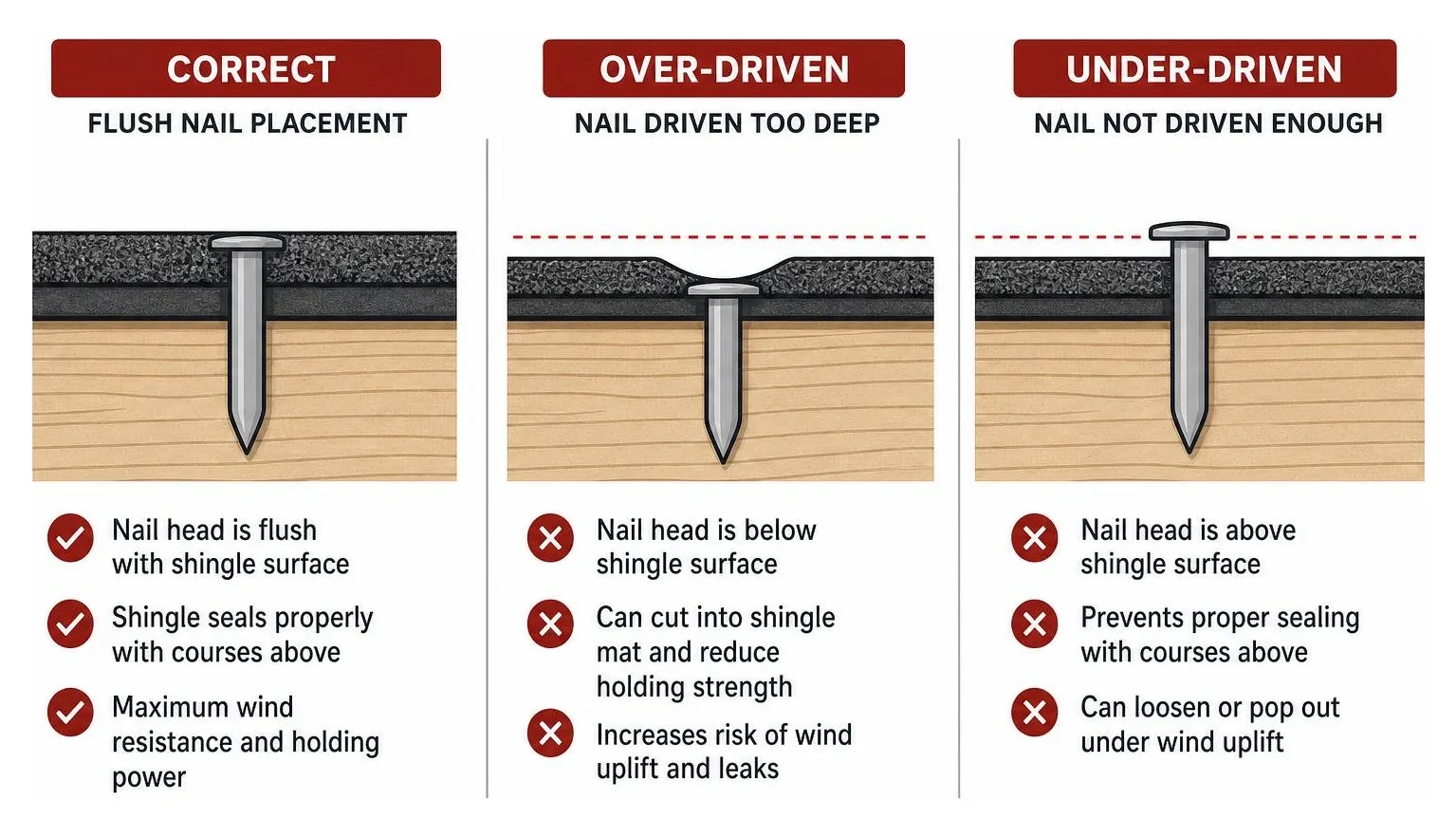
Arkansas building codes enforce strict standards to ensure roofs can withstand storm corridor weather. Under the International Residential Code (IRC) Chapter 9, standard installations require a minimum of 4 nails per shingle. However, in our high-wind zones, a 6-nail fastening pattern is highly recommended.
Where the fasteners are driven matters just as much as how many are used. Improperly driven fasteners—whether over-driven (cutting into the shingle) or under-driven (sitting proud and preventing the shingle above from sealing)—significantly reduce a shingle’s wind pull-through resistance.
Furthermore, the code mandates modern underlayment standards. Traditional organic felt paper is increasingly replaced by synthetic underlayment, which offers vastly superior tear strength and water resistance during high-wind events.
In areas prone to freezing winter weather, like the elevated areas around Hot Springs Village, installing self-adhering ice and water shields along eaves, valleys, and penetrations is crucial to prevent leaks caused by winter ice damming. To understand how winter ice and summer heat affect your installation requirements, read our In-Depth Guide to Ice vs Summer Roof Damage in Arkansas.
Mitigating Risk: Material Upgrades and Contractor Selection
The best defense against the Arkansas storm corridor is choosing the right materials and a qualified, local contractor. For guidance on selecting a trustworthy partner in our region, see Choosing a Roofing Contractor in Central Arkansas and learn How to Verify a Roofing Contractor is Licensed and Insured in Arkansas.
How the Arkansas Storm Corridor Creates Unique Roofing Challenges for Material Selection
When upgrading your roof to handle severe weather, your primary choice is between standard architectural shingles, Class 4 impact-resistant shingles, and standing seam metal roofing.
Class 4 shingles are certified under the UL 2218 testing protocol, which involves dropping a 2-inch steel ball from a height of 20 feet directly onto the shingle to ensure it does not crack or fracture. While Class 4 shingles carry a material cost premium of 10% to 20% over standard architectural shingles, they stand up far better to golf ball-sized hail and often qualify homeowners for an annual insurance premium discount, which varies by insurer.
For the ultimate in storm protection, standing seam metal roofing is the premium choice. Unlike exposed-fastener metal panels, standing seam systems utilize concealed clips that allow the metal to expand and contract naturally during extreme thermal cycling without backing out screws or creating leak points. Metal roofs last 40 to 60 years, reflect up to 80% of solar radiation to lower summer cooling bills, and offer unmatched wind resistance.
Avoiding Post-Storm Scams and Storm Chasers
Following a major storm event in Central Arkansas, out-of-state “storm chasers” often flood neighborhoods offering free roofs and high-pressure sales pitches. These transient companies often perform subpar work, ignore local building codes, and vanish before their warranties can be tested.
Protect yourself by working with an established, locally based contractor. Ensure they are fully licensed by the Arkansas Contractors Licensing Board and carry active general liability and workers’ compensation insurance. A reputable local contractor will provide forensic-grade digital documentation, including drone photography and wind-lift mapping, to ensure your insurance claim is filed accurately and ethically.
To protect your investment, read Everything You Need to Know About Storm Chasing Roofing Scams in Arkansas and learn How to Spot Storm Chasing Roofers in Arkansas.
Frequently Asked Questions about Arkansas Storm Damage
What is the Arkansas storm corridor?
The Arkansas storm corridor refers to the geographic pathway running through the center of the state—often traced from Texarkana through the Little Rock metro area to Jonesboro—where the physical funneling of the Arkansas River Valley and neighboring mountain ranges concentrates severe thunderstorms, large hail, high winds, and tornado activity.
How does hail damage asphalt shingles?
Hail damages shingles through high-velocity impact that displaces the protective mineral granules on the surface. This impact bruises the asphalt layer and micro-fractures the fiberglass mat backing underneath, leaving the shingle vulnerable to water infiltration and accelerated UV degradation.
Should I call a roofer or my insurance company first after a storm?
We highly recommend calling a licensed local roofing contractor first. A professional contractor can perform a comprehensive, forensic inspection to document the exact scope of any damage. This digital evidence helps you avoid filing a frivolous claim if no structural damage is present, and provides clear documentation to support your claim if repairs are needed. For a detailed guide on what to do immediately after a storm, read about the Steps Take After Storm Damage Roof Little Rock.
Conclusion
The unique geography and severe weather patterns of the Arkansas storm corridor make high-quality roofing materials and expert installation a necessity, not a luxury. Protecting your home in this demanding climate requires a local partner who understands the specific wind, hail, and thermal challenges of our region.
At Patriot Roofing & Restoration, we serve homeowners across Central Arkansas—including Little Rock, North Little Rock, West Little Rock, Alexander, Austin, Benton, Bryant, Cabot, Conway, Hot Springs, Hot Springs Village, Jacksonville, Maumelle, Mayflower, Scott, and Sherwood.
Our quality-first approach is backed by our four written guarantees, our exclusive four written guarantees, and our Atlas PRO+ Gold standing. Whether you are recovering from a recent storm or looking to upgrade to a resilient standing seam metal system, we are here to provide the long-term protection your home deserves.
Ready to secure your home against the next storm? Explore our premium Metal Roofing Arkansas solutions or contact us today to schedule your forensic roof inspection.
This article is general information about roofing and storm damage in Arkansas, not insurance advice. Coverage, deductibles and claim deadlines vary by policy and by carrier. Confirm your own coverage with your insurance agent before you make a decision.