

Why Arkansas Weather Is One of the Harshest Environments for Roofing in the U.S.
How Arkansas weather shortens roof lifespan compared to milder climates comes down to four climate stressors hitting your roof at the same time: intense UV exposure, dramatic temperature swings, heavy moisture, and violent storms. While a roof in a mild-climate state like Oregon or the mid-Atlantic might last 25–30 years, the same materials installed in Arkansas often give out significantly sooner.
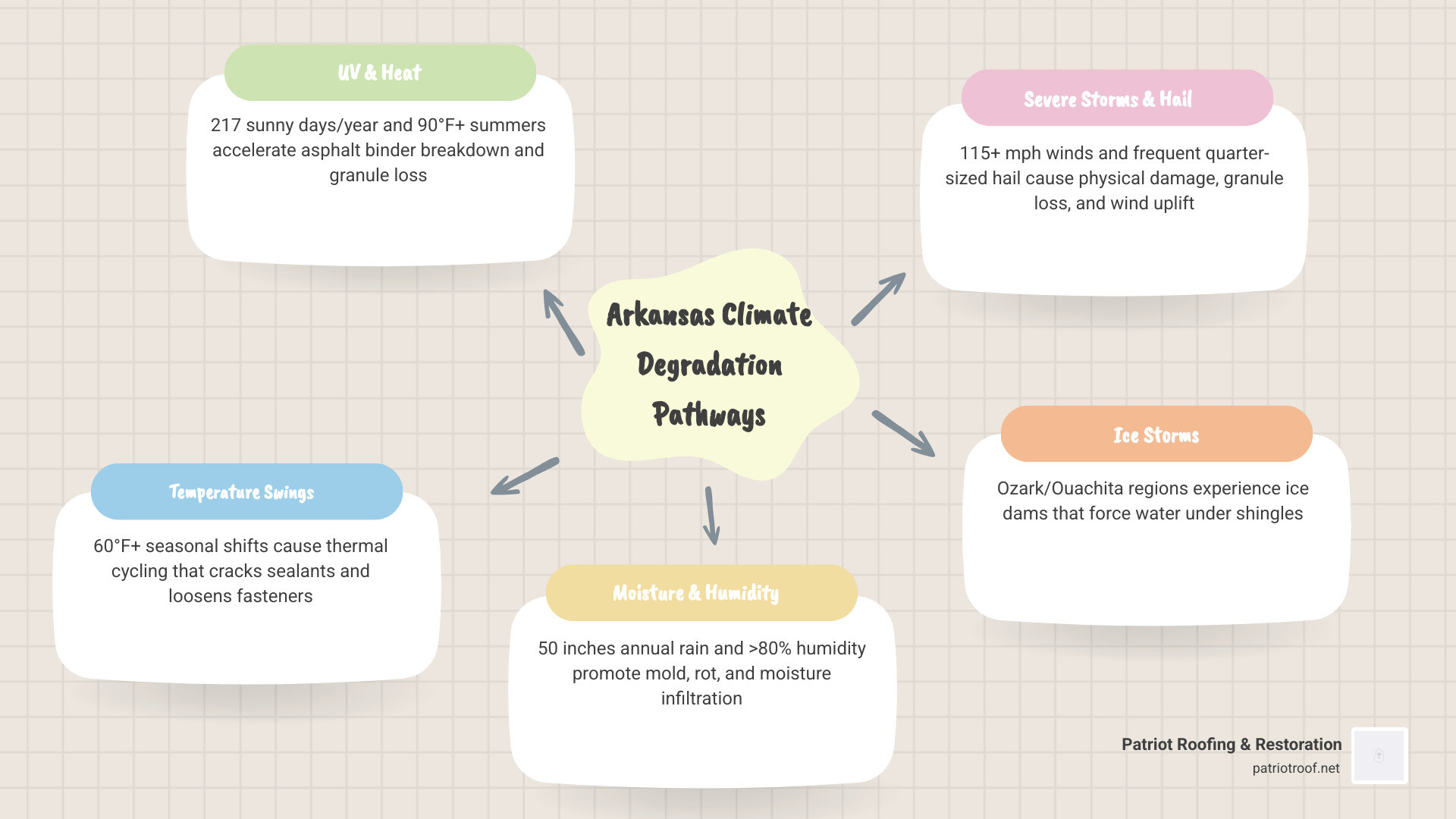
Here’s a quick summary of the key ways Arkansas climate cuts roof life short:
| Climate Stressor | Arkansas Conditions | Impact on Roof Lifespan |
|---|---|---|
| UV & Heat | ~217 sunny days/year; 90°F+ summers | Accelerates asphalt binder breakdown and granule loss |
| Temperature Swings | 60°F+ shifts between seasons | Thermal cycling cracks sealants and loosens fasteners |
| Moisture & Humidity | ~50 inches rain/year; humidity often >80% | Promotes mold, rot, and moisture infiltration |
| Severe Storms & Hail | 115+ mph design wind speeds; frequent quarter-sized hail | Physical damage, granule loss, wind uplift |
| Ice Storms | Ozark/Ouachita mountain regions | Ice dams force water under shingles |
The national average lifespan for asphalt shingles is 20–30 years. In Arkansas — and similar high-stress Southern states — that number drops to 15–20 years for architectural shingles and as few as 12–18 years for 3-tab shingles. That’s a reduction of 25–40% compared to manufacturer estimates, which are typically based on mild-climate testing.
What makes Arkansas especially tough on roofs isn’t any single factor — it’s the compound effect of all four degradation pathways working together, year after year.
Understanding How Arkansas Weather Shortens Roof Lifespan Compared to Milder Climates
When roofing manufacturers calculate the expected lifespan of their products, they often do so under idealized laboratory conditions or in mild, stable climates. However, our local service areas—including Little Rock, Maumelle, Sherwood, and Hot Springs—experience a unique convergence of Gulf moisture, continental air masses, and regional topography. This creates a highly demanding climate that forces roofing systems to work overtime.
To understand why roofs fail prematurely in the Natural State, we have to look at how different environmental forces interact. A roof in a milder, drier climate might only have to contend with one major stressor, such as dry heat. In contrast, an Arkansas roof is subjected to a relentless rotation of four distinct mechanical degradation pathways:
- Thermal Cycling: Rapid expansion and contraction that weakens structural bonds.
- Moisture Infiltration: Constant rain, humidity, and winter ice that exploit micro-cracks.
- UV Radiation: Intense sunlight that chemically alters and embrittles asphalt materials.
- Wind and Hail Impact: Physical trauma from severe seasonal storms.
When these four forces operate simultaneously, they create a compound degradation effect. For example, UV rays dry out a shingle and cause micro-cracks. Moisture then seeps into those cracks. When the temperature drops, that water freezes and expands, widening the cracks. Finally, a high-wind event or a hail storm hits the already weakened shingle, causing it to tear or blow off entirely. This interconnected cycle is the primary reason why standard roofing materials rarely reach their maximum advertised lifespans in our region.
Thermal Cycling and UV: How Arkansas Weather Shortens Roof Lifespan Compared to Milder Climates
Arkansas averages approximately 217 sunny days per year, delivering sustained ultraviolet (UV) exposure directly to your roof deck. At the molecular level, UV radiation breaks down the complex chemical bonds of the asphalt binder within shingles. As the binder oxidizes, it loses its flexibility and volatilizes. This process leads directly to granule loss—the shedding of those tiny, sand-like protective stones that shield the underlying asphalt mat from the sun. Without these granules, the shingles quickly bald, cup, curl, and blister.
Compounding this intense UV exposure is the phenomenon of thermal cycling. In areas like Little Rock and Conway, it is not uncommon to experience daily or seasonal temperature swings of 60°F or more. When the sun beats down during a hot summer afternoon, roof surface temperatures can easily climb to 150°F or higher. Once a sudden afternoon thunderstorm rolls through, or the sun sets, that temperature drops rapidly.
This constant expansion and contraction puts immense physical stress on every component of your roof:
- Shingles: Become brittle, crack, and lose their adhesive seal.
- Sealants: Dry out, shrink, and pull away from joints.
- Metal Flashings: Expand and contract at different rates than the surrounding wood and asphalt, backing out fasteners and creating gap entry points for water.
To help protect your home from these harsh summer conditions, check out our guide on Tips Help Prepare Roof Summer Weather Maumelle to minimize heat-related wear.
Moisture and Ice Dams: How Arkansas Weather Shortens Roof Lifespan Compared to Milder Climates
With an average annual precipitation of approximately 50 inches—well above the national average of about 30 inches—Arkansas roofs are exposed to a massive volume of water. When you combine this heavy rainfall with summer relative humidity levels that frequently exceed 80%, you get an environment where moisture struggles to evaporate.
This persistent dampness accelerates material fatigue in several ways:
- Algae and Moss Growth: Prolonged wet periods promote organic growth, particularly on north-facing roof slopes shaded by trees in areas like West Little Rock and Hot Springs Village. These organisms trap moisture against the shingles, slowly digesting the limestone filler in the asphalt.
- Rot and Mold: If moisture manages to penetrate the outer roofing barrier, the high humidity prevents the wooden decking and rafters from drying out, leading to structural rot and mold in unconditioned attic spaces.
Winter brings its own set of moisture challenges, particularly in the hilly terrains of the Ouachita foothills and northern parts of our service area. Ice storms and rapid freeze-thaw cycles can lead to ice damming. An ice dam forms when heat escaping from an under-insulated attic melts snow or ice on the upper sections of the roof. As the meltwater flows down to the colder eaves, it refreezes, creating a solid barrier of ice.
Subsequent runoff pools behind this ice dam, finding its way under the shingles through capillary action. Once water gets beneath the shingles, it rots the decking and damages interior ceilings. To ensure your home is ready for these freezing threats, refer to our comprehensive Preparing Roof for Winter Maintenance Checklist Little Rock.
Regional Lifespan Comparison: Arkansas vs. Milder Climates
Because of these demanding local conditions, roofing systems in Arkansas simply do not last as long as they do in milder regions of the country. If you are comparing regional roof lifespans, it is essential to look at realistic, climate-adjusted expectations rather than generic manufacturer warranty periods.
The table below illustrates how the expected lifespan of common roofing materials is compressed in Arkansas compared to national averages:
| Roofing Material | National Average Lifespan | Expected Lifespan in Arkansas | Average Lifespan Reduction |
|---|---|---|---|
| 3-Tab Asphalt Shingles | 15 – 20 Years | 12 – 18 Years | 15% – 20% |
| Architectural Shingles | 25 – 30 Years | 15 – 20 Years | 25% – 40% |
| Standing Seam Metal | 40 – 70 Years | 35 – 50 Years | 12% – 28% |
| Clay / Concrete Tile | 75 – 100 Years | 50 – 75 Years | 25% – 33% |
To learn more about general roof longevity baselines, you can read our detailed article, How Long Do Most Roofs Last?.
Asphalt Shingle Longevity in the Natural State
Asphalt shingles remain the most popular choice for homeowners in Alexander, Bryant, Cabot, and Jacksonville. However, their performance is highly sensitive to climate.
The two primary types of asphalt shingles perform very differently under Arkansas weather pressures:
- 3-Tab Shingles: These are single-layer, flat shingles. Because they are thin and light, they have very little resistance to high winds and thermal cycling. In Arkansas, 3-tab shingles are highly susceptible to wind uplift and rapid granule loss. To understand their specific limitations, read How Long Does 3 Tab Shingles Last?.
- Architectural Shingles: Also known as dimensional shingles, these are multi-layered and laminated over a heavier fiberglass mat. They offer much better wind resistance and structural durability. However, even these robust systems see their lifespans shortened by the local climate. For a deep dive into their performance, check out How Long Does Architectural Shingles Last? and our broader analysis on How Long Will Asphalt Shingl Roof Last?.
Metal and Tile Performance Under Southern Skies
For homeowners looking to break the cycle of replacing asphalt shingles every 15 years, alternative materials like metal and tile are highly attractive options.
- Metal Roofing: Standing seam metal roofing is exceptionally durable. It easily sheds water, resists high winds, and reflects solar heat, which can reduce summer cooling costs. However, metal is not entirely immune to Arkansas weather. The intense daily temperature swings cause significant thermal movement. Over decades, this expansion and contraction puts stress on fasteners and neoprene washers. If exposed fasteners are used, they must be inspected and tightened periodically to prevent leaks.
- Clay and Concrete Tile: These materials excel at resisting UV degradation and shedding heavy rainfall. They can easily last 50 to 75 years in our climate. However, they are heavy, requiring a reinforced roof structure, and can be vulnerable to cracking under the impact of severe, large-scale hail events.
Severe Storms, Wind Uplift, and Hail Damage in Arkansas
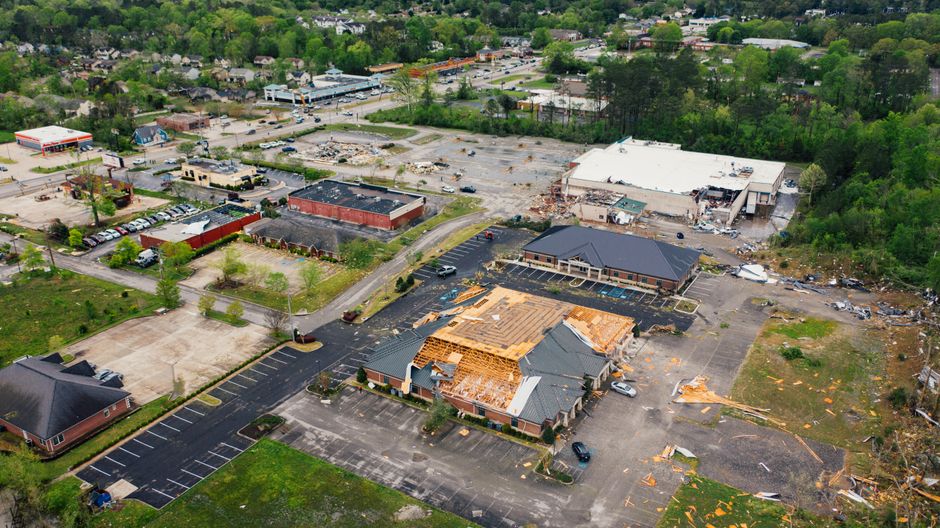
Arkansas lies in a highly active storm corridor characterized by severe spring and summer thunderstorms, straight-line winds, and tornadoes. Under the ASCE 7-22 building design standards, residential roofs in our most exposed zones must be designed to withstand wind speeds of 115 mph or higher.
When high winds sweep across a roof, they create a pressure differential known as wind uplift. This force lifts the edges of shingles, breaking their adhesive seals. Once a shingle’s seal is broken, it can flutter, crease, or blow off entirely, leaving the underlying wooden deck exposed to driving rain.
Hail is another major threat to roof longevity in our communities. Arkansas frequently experiences severe hail storms, often producing stones that are quarter-sized (1 inch in diameter) or larger.
When hail strikes an asphalt shingle, the damage is immediate and often hidden:
- Mat Bruising: The impact fractures the fiberglass reinforcement mat inside the shingle.
- Granule Displacement: Hail knocks away the protective mineral granules, exposing the dark asphalt underneath.
- Accelerated UV Decay: Even if the hail doesn’t cause an immediate leak, the newly exposed asphalt will degrade rapidly under the sun, causing the shingle to fail years ahead of its time.
Our local teams have documented these severe patterns firsthand. You can read about local storm impacts in our reports on the 1 11 24 Severe Storm Hail Damage Heavy Winds Little Rock and Maumelle and 4 16 24 Hail Damages Roland Roofs. If your property has recently been hit by a storm, follow our step-by-step guide on Steps Take After Storm Damage Roof Little Rock to protect your home and navigate the recovery process.
Mitigating Arkansas Climate Stressors: Building Codes and Material Standards
While you cannot change the Arkansas weather, you can dramatically improve your roof’s ability to survive it by adhering to strict building codes and selecting premium, climate-appropriate materials.
1. Proper Attic Ventilation (IRC R806)
Under the International Residential Code (IRC) Section R806, unconditioned attics must maintain a minimum net-free ventilation ratio of 1:150 (one square foot of venting for every 150 square feet of attic floor space). This ratio can sometimes be reduced to 1:300 if balanced correctly between intake (soffit) and exhaust (ridge) vents. Proper ventilation is critical because it:
- Lowers peak attic temperatures by 20°F to 30°F, preventing shingles from “double baking” from both above and below.
- Flushes out moisture and high humidity, preventing mold and wood rot.
- Minimizes the temperature differentials that cause winter ice dams.
2. Impact-Resistant (Class 4) Shingles
To defend against frequent hail events, we highly recommend upgrading to shingles rated under UL 2218 Class 4. During UL testing, these shingles must withstand the impact of a 2-inch steel ball dropped from a height of 20 feet without cracking or tearing. Many insurance carriers in Arkansas offer substantial premium discounts for homes protected by Class 4 impact-resistant roofing.
3. Wind-Rated Fastening and Local Codes
Following the Arkansas Fire Prevention Code and ASCE 7-22 standards, roofs must be installed using enhanced fastening patterns. For asphalt shingles, this means using six nails instead of the standard four, and ensuring nails are placed precisely within the manufacturer’s designated nail line. This simple adjustment dramatically increases a shingle’s wind resistance rating from 110 mph to 130 mph.
Frequently Asked Questions about Arkansas Roof Lifespans
Why do roofs fail faster in Arkansas than in northern states?
Roofs in northern states primarily deal with snow and cold, with relatively mild summers. Arkansas roofs face a brutal combination of extreme summer heat (which bakes the shingles), high humidity (which prevents drying and encourages rot), intense UV radiation, and frequent severe storms with high winds and hail. This simultaneous combination of all four major degradation pathways wears down materials much faster than single-stressor climates.
Does insurance cover roof replacement due to weather wear in Arkansas?
Standard homeowners insurance policies cover sudden and accidental storm damage, such as wind-blown shingles or impact from a documented hail storm. However, they do not cover general wear and tear, cosmetic aging, or damage resulting from a lack of maintenance. Because of the high volume of storm claims in Arkansas, many policies now include separate wind/hail deductibles (often a percentage of the home’s value rather than a flat fee) and may use actual cash value (ACV) roof-age schedules for older roofs.
What is the best roofing material for Arkansas’s climate?
For most homeowners, the best balance of cost and performance is found in Class 4 impact-resistant architectural shingles installed with an upgraded six-nail pattern and balanced attic ventilation. For those looking for maximum longevity and energy efficiency, standing seam metal roofing is an excellent investment, as it reflects solar heat and easily handles high winds and heavy rains.
Conclusion
Arkansas weather is undeniably tough on roofs, but a proactive approach can save you from premature replacement costs. By choosing high-quality, impact-resistant materials, ensuring your attic meets IRC R806 ventilation standards, and scheduling regular professional maintenance, you can successfully push back against the natural wear of our climate.
At Patriot Roofing & Restoration, we specialize in helping homeowners throughout Little Rock, North Little Rock, Maumelle, Conway, Benton, Bryant, and surrounding areas maximize their roof’s lifespan. We bring a quality-first approach to every project, backed by our four written guarantees and our standing as an Atlas PRO+ contractor at the Gold level.
Whether you are interested in upgrading to a durable asphalt system or exploring the long-term benefits of Metal Roofing Arkansas, our local team is here to help. Contact us today to schedule a comprehensive roof inspection and ensure your home remains safe and secure through every season.