
Why Knowing What Questions to Ask a Roofer Before Signing a Contract Can Save You Thousands
Knowing what questions to ask a roofer before signing a contract is one of the most important steps you can take before committing to one of the largest home improvement expenses you’ll ever face. Roofing companies come and go, which is why a warranty is only as good as the company standing behind it. Check how long a contractor has been trading and whether their Better Business Bureau complaints were resolved. That means the wrong hire doesn’t just cost money. It can leave you with no one to call when leaks appear.
Before you sign anything, here are the essential questions to ask:
- What is your full legal business name, physical address, and license number?
- Can you provide proof of current general liability and workers’ compensation insurance?
- Do you use subcontractors, and are they licensed and insured?
- Can you provide recent local references from the last 6–12 months?
- What is included in the written estimate, and what is the payment schedule?
- What workmanship warranty do you offer, and is it transferable?
- How will you protect my home, landscaping, and property during the project?
- What happens if hidden damage or rotted decking is found mid-job?
- How long will the project take, and what is your weather delay policy?
- What materials will you use, and will you install a complete matching system?
For Little Rock homeowners dealing with harsh Arkansas weather — hail, heavy rain, and summer heat — asking the right questions upfront is the difference between a roof that protects your home for decades and one that fails within a few years. A professional contractor expects these questions. If they hesitate or get defensive, that tells you something important.
Related reading:
- choosing a roofing contractor in central arkansas
- how to spot storm-chasing roofers after a severe weather event in arkansas
Vetting Legitimacy: What Questions to Ask a Roofer Before Signing a Contract
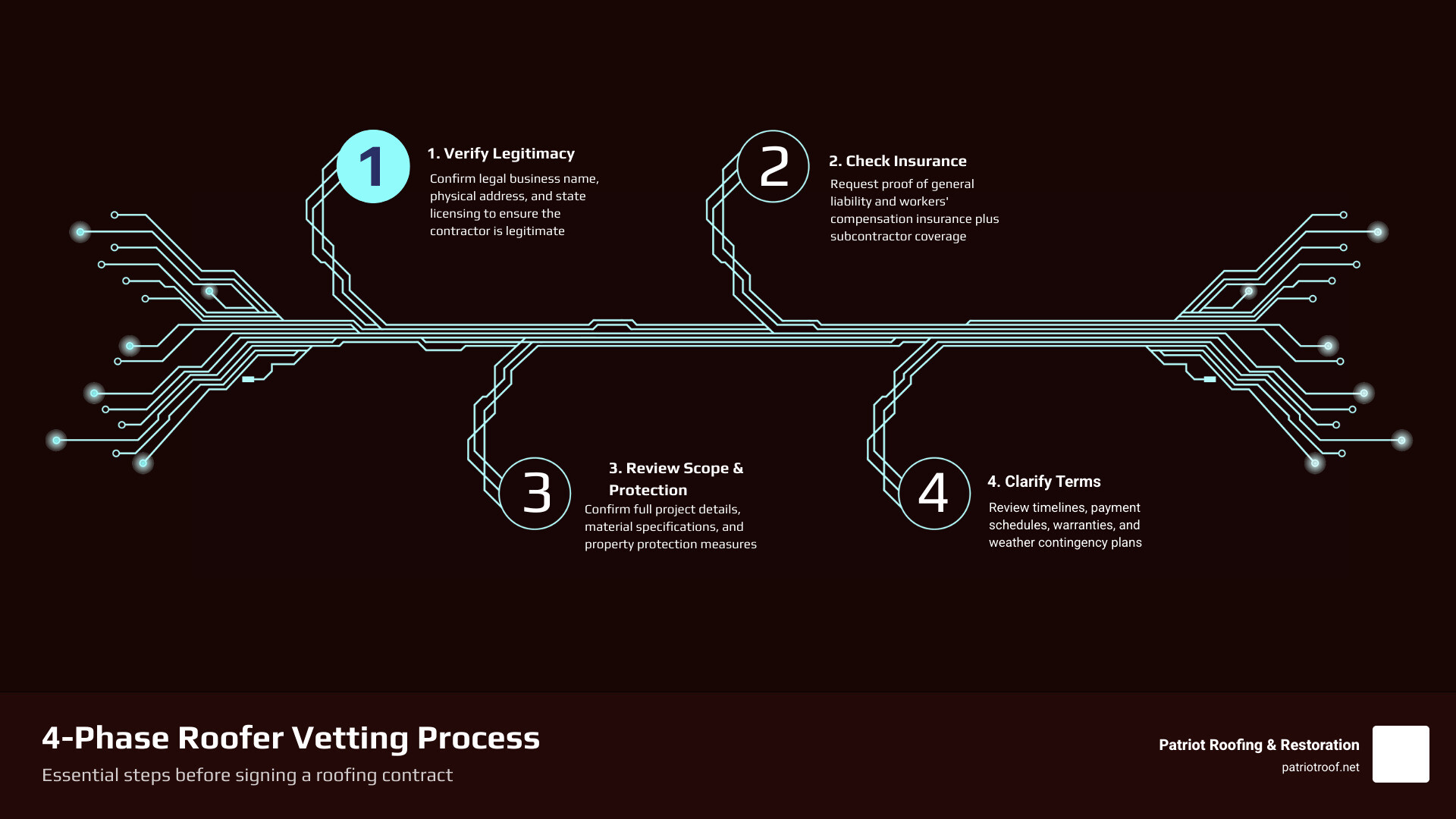
Before diving into shingle colors or scheduling, you must verify that the company you are talking to is a legitimate, legally compliant business. In the roofing industry, “fly-by-night” operators are unfortunately common. Vetting a contractor’s basic business credentials is your first and strongest line of defense.
Reputable contractors who plan to stand by their work will happily provide their corporate documentation, physical office locations, and state licensing details. If a contractor gets annoyed by these initial questions, consider it an immediate red flag and walk away.
Essential Identity Questions to Ask a Roofer Before Signing a Contract
The first phase of your interview should focus on the business’s identity and legal standing in Arkansas.
- “What is your full legal business name and physical office address?” Never accept a P.O. Box or a UPS Store address. A permanent, brick-and-mortar office indicates that the company is rooted in the community. If they only have a truck and a cell phone, they can easily disappear if a leak occurs next winter. You can use online mapping tools to verify that their address is an actual commercial office or warehouse, not an empty lot or a residential home.
- “What is your Arkansas contractor license number?” In Arkansas, residential roofing contractors must be properly licensed by the state. Asking for this number allows you to verify their status directly on the Arkansas Contractors Licensing Board website. This ensures their license is active, in good standing, and free of active disciplinary actions.
- “Will you handle pulling the necessary building permits?” A legitimate contractor should always pull the permits. If a contractor asks you to pull the permit as the homeowner, it usually means they aren’t licensed or want to avoid liability. For local guidelines on this, read our guide on How to Check Permit Requirements for a Roof Replacement in Little Rock or Maumelle Arkansas.
Confirming Insurance and Subcontractor Policies
Roofing is one of the most dangerous residential trades. If an uninsured worker falls on your property, or if a crew member accidentally punctures a water pipe, you could be held financially liable.
- “Can you provide proof of current general liability and workers’ compensation insurance?” Do not just take their word for it, and do not accept a printed PDF that could have been edited. Ask the contractor to have their insurance agency email a Certificate of Insurance (COI) directly to you. A reputable contractor will carry at least $1 million to $2 million in general liability coverage, along with active workers’ compensation insurance to protect every worker on your roof.
- “Do you use subcontractors, and how do you ensure they are licensed and insured?” Many roofing companies use subcontractor crews rather than in-house W-2 employees. While subcontracting is a common industry practice, you need to know exactly who is working on your home. Ask if the subcontractor crews are covered under the main contractor’s insurance policies, and how the company supervises them on-site. For a deeper dive into this topic, see our article on Choosing a Roofing Contractor in Central Arkansas.
Project Scope, Materials, and Property Protection
A high-quality roof is not just a collection of shingles nailed to wood. It is an engineered system designed to shed water, resist high winds, and properly ventilate your attic. Understanding the exact materials being used and how the crew will treat your property during installation is crucial.
Material and System Questions to Ask a Roofer Before Signing a Contract
To get a roof that lasts, you need to ask about the specific components of the roofing system.
- “Will you install a complete, matching system of roof components from the same manufacturer?” Mixing and matching underlayment from one brand, starter shingles from another, and field shingles from a third to save a few dollars is a poor practice. Most major manufacturers will only honor their extended system warranties if all key components (ice and water shield, synthetic underlayment, starter strips, shingles, and ridge caps) come from their brand.
- “What is your plan for attic ventilation?” Improper ventilation is one of the leading causes of premature roof failure and high energy bills. A standard roof should have one square foot of net free ventilation area for every 150 square feet of attic floor space. Ask your roofer if they will inspect your current intake (soffit) and exhaust (ridge or box) vents to ensure your system is balanced. To understand whether your roof needs a simple fix or a full upgrade, check out The Definitive Guide to Roof Repair vs Replacement.
Property Protection and Handling Hidden Damage
A typical roof tear-off creates thousands of pounds of heavy, sharp debris. If the crew is not careful, your gutters, siding, and landscaping can easily be damaged.
- “How will you protect my landscaping, gutters, and driveway?” Ask if the crew will use heavy-duty tarps draped from the roofline to protect your flowerbeds and bushes. They should also use wooden boards to protect your driveway from being cracked by heavy dumpsters or delivery trucks. Gutters should be supported with ladder stabilizers so they aren’t crushed during the tear-off and installation.
- “What is your cleanup and nail recovery protocol?” Roofing nails have a habit of finding their way into car tires and pet paws. Ask how many times the crew will sweep your yard, driveway, and walkways with powerful rolling magnets. A professional crew will perform magnetic sweeps throughout the day and do a final, thorough sweep before leaving.
- “What happens if you find hidden damage or rotted decking?” When the old shingles are torn off, the crew may find rotted plywood decking underneath. Ask how this is handled and get a fixed price per sheet of plywood written directly into the contract upfront. This prevents surprise charges mid-project. If you want to know what a thorough inspection should look like before the project even starts, read Everything You Need to Know About What Does a Professional Roof Inspection Include in Central Arkansas.
Timelines, Warranties, and Financial Agreements
Clear communication regarding project scheduling, payment structures, and warranty coverage protects both your wallet and your peace of mind. Never rely on verbal promises; make sure every detail is clearly written into your contract.
Project Timelines and Weather Contingencies
Arkansas weather can change rapidly, making project management and contingency planning essential.
- “How long will the project take from start to finish?” For an average-sized home, a professional roofing crew can typically complete a tear-off and installation in 1 to 2 days. Larger or highly complex roofs may take 3 days or more.
- “What is your policy for unexpected weather delays?” If the weather forecast calls for rain, a reputable roofer will not open up your roof. However, if an unexpected storm rolls in while your roof is exposed, the contractor must have a clear emergency protocol. Ask if they keep heavy-duty, commercial-grade tarps on-site and if they have a dedicated crew ready to secure your home immediately. For more details on scheduling expectations, see our article How Long Does Roof Replacement Take in Central Arkansas.
Estimates, Payment Schedules, and Warranties
Financial transparency is key to a stress-free roofing project. You should always receive a line-item estimate that breaks down the cost of materials, labor, permits, and disposal.
- “What is your payment schedule?” Never work with a contractor who demands 100% of the payment upfront. A standard, professional payment schedule typically requires a deposit of 10% to 30% upon signing the contract (to secure the materials and schedule), a secondary payment when materials are delivered or work begins, and the final balance only after the job is fully completed, cleaned up, and has passed a walkthrough inspection. If you are exploring financing options, check out our resource A Practical Guide to Roofing Financing for Arkansas Homeowners.
- “What warranties do you offer, and are they transferable?” It is vital to understand the difference between the manufacturer’s warranty and the contractor’s workmanship warranty.
| Warranty Type | What It Covers | Typical Duration |
|---|---|---|
| Manufacturer Warranty | Material defects in the shingles or system components | 25 to 50 years (often prorated) |
| Workmanship Warranty | Installation errors, leaks, and labor-related issues | 2 to 10+ years (offered by contractor) |
Always ask if both warranties are transferable to the next homeowner if you decide to sell your home. A transferable warranty can be a powerful selling point in the local real estate market.
Spotting Red Flags and Storm Chasers
Central Arkansas is no stranger to severe weather, including heavy spring storms, hail, and tornadoes. Unfortunately, these weather events often attract out-of-state “storm chasers”—unlicensed, uninsured contractors who travel from state to state looking for quick insurance payouts.
Identifying Out-of-State Storm Chasers
Storm chasers typically use high-pressure sales tactics. They often knock on doors immediately after a storm, offering “free inspections” and claiming they can get you a new roof for free.
- “Are you a local company with a physical office nearby?” Ask to see their local business license and check their vehicle license plates. Storm chasers often rent local phone numbers or use P.O. Boxes to appear local, but their actual operations are based out of state. Once they collect your insurance check and install a cheap, sub-standard roof, they will leave town. If your roof begins to leak a few months later, you will have no way to contact them. To protect your home, read our guide on How to Spot Storm Chasing Roofers in Arkansas.
Avoiding Insurance Fraud and Scams
Some door-to-door roofers will offer to “waive” or “absorb” your insurance deductible. While this might sound like a great deal, it is actually a serious crime.
- “How do you handle insurance deductibles?” In Arkansas, it is illegal for a roofing contractor to pay, waive, or rebate your insurance deductible. Any contractor who offers to do this is committing insurance fraud and encouraging you to do the same. Reputable contractors will always bill honestly and expect you to pay your legal deductible.
- “Will you represent me during the insurance adjuster’s meeting?” If your roof has suffered storm damage, your insurance company will send an adjuster to inspect the property. A professional local contractor will gladly meet the adjuster on-site to walk the roof together, pointing out all areas of wind or hail damage to ensure your claim is documented properly. For more warning signs to watch out for, read Everything You Need to Know About Storm Chasing Roofing Scams in Arkansas.
Frequently Asked Questions About Hiring a Roofer
How do I verify a roofer’s license and insurance?
You can verify an Arkansas roofing contractor’s license by visiting the Arkansas Contractors Licensing Board website and searching their business name. To verify their insurance, ask the contractor for their insurance certificate and call the insurance agency listed on the certificate directly to confirm that the policy is active and has sufficient coverage limits.
What is a reasonable deposit to pay a roofer upfront?
A reasonable upfront deposit is typically between 10% and 30% of the total project cost. This deposit is used to secure your spot on the schedule and order materials. You should never pay more than 50% upfront, and you should never make the final payment until the roof is completely installed, the yard is clean, and you are satisfied with the final walkthrough.
What is the difference between a manufacturer warranty and a workmanship warranty?
A manufacturer warranty covers defects in the physical roofing materials (such as shingles cracking or losing granules prematurely). A workmanship warranty is provided by the contractor and covers installation errors (such as shingles blowing off due to improper nailing or leaks around flashing). You need both to ensure your roof is fully protected.
Conclusion: Partner with a Trusted Central Arkansas Professional
Asking what questions to ask a roofer before signing a contract is the best way to protect your home, your family, and your hard-earned money. By taking the time to vet a contractor’s licensing, insurance, material systems, and warranties, you can make your decision with complete confidence.
At Patriot Roofing & Restoration, we believe in complete transparency and a quality-first approach. We serve homeowners across Central Arkansas—including Little Rock, Maumelle, Benton, Bryant, Conway, Cabot, and Sherwood—with top-tier installations, repairs, and maintenance. As an Atlas PRO+ contractor at the Gold level, we back our work with our four written guarantees.
Ready to work with a roofing team that welcomes your hard questions? Contact us today to schedule your professional inspection and get a detailed, honest estimate for your home.
This article is general information about roofing and storm damage in Arkansas, not insurance advice. Coverage, deductibles and claim deadlines vary by policy and by carrier. Confirm your own coverage with your insurance agent before you make a decision.