
Solar Attic Fan vs Ridge Vent: Which Is Better for Your Attic?
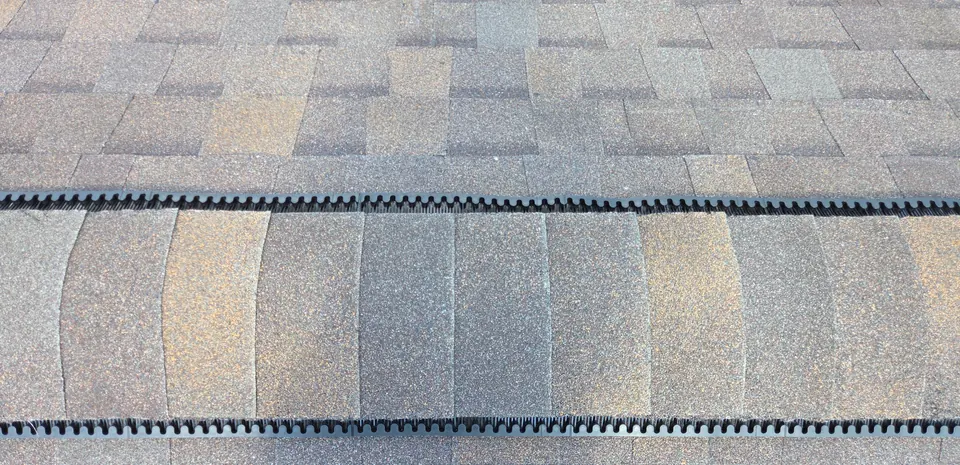
For most Central Arkansas homes getting a new roof with a long, straight ridge, a ridge vent is the better choice: it has no moving parts, works day and night in every season, and comes with the roof. A solar attic fan is the better choice when the ridge is too short for a ridge vent (a hip roof, for example), when you want more airflow on a roof you are not replacing, or when a sunny, hot attic holds ducts or the air handler. What you should not do is put both on the same attic without a plan, because two kinds of exhaust can pull against each other. Either way, neither one works without enough intake vents under the eaves.
We are Patriot Roofing and Restoration in Maumelle. We install both: ridge vents with every Armor, Shield Plus and Shield roof, and Attic Breeze solar attic fans on new and existing roofs, so we have no reason to push one over the other. Product figures below come from the makers' own pages and data sheets (Attic Breeze, Lomanco and Atlas), checked November 20, 2026.
How each one works
Ridge vent: passive, all the time
A ridge vent runs along the peak of the roof. The crew cuts a slot in the deck at the ridge, lays the vent over it and covers it with ridge cap shingles, so from the street it looks like a normal ridge line. Warm air rises out of the slot on its own, and wind passing over the roof pulls more out. Lomanco, a vent maker, says a ridge vent needs an exterior baffle to work, because wind over the baffle lowers the pressure at the ridge and draws air out of the attic. Lomanco and Atlas both list several of their shingle-over ridge vents at 18 square inches of net free area (NFA) per foot of ridge.
Because it is passive, a ridge vent never stops. It vents on hot afternoons, at night and on cold winter days, when the job is carrying moisture out before it condenses on the underside of the roof deck. It uses no power and has nothing to wear out.
Solar attic fan: active, while the sun is up
A solar attic fan is an exhaust fan on the roof with its own small solar panel. When sun hits the panel, the fan pulls hot, damp air out of the attic and outside air comes in through the soffit vents to replace it. It needs no wiring and adds nothing to your power bill, and because it is not hooked to house power, no electrician is needed.
Attic Breeze, the maker of the fans we install, rates its 35 watt fan at up to 1,775 cubic feet per minute and says rated airflow figures are stated at full sun. It also says plainly that the fan does not run after dark, and that on an overcast day it still moves air, just less of it. Attic Breeze's current data sheet for its UltraBreeze curb-mount fans lists a thermal control that turns the fan on at about 75 degrees and off at about 55 degrees, so in cool weather the fan rests and the attic relies on its passive openings.
Solar attic fan vs ridge vent, side by side
| Ridge vent | Solar attic fan | |
|---|---|---|
| How it moves air | Passive: rising warm air and wind over the ridge | Active: a fan powered by its own solar panel |
| When it works | All day, all night, every season | While the sun is on the panel; less under cloud, not after dark |
| Best roof shape | A long ridge line | Any shape, including hip roofs with little ridge |
| Airflow | Set by ridge length (18 sq in NFA per foot on several Lomanco and Atlas vents) | Up to 1,775 CFM in full sun for Attic Breeze's 35 watt fan |
| Intake needed | Lomanco says intake "should meet or slightly exceed" exhaust | Attic Breeze lists 7.0 sq ft (1,008 sq in) of intake NFA as the minimum for its 35 watt UltraBreeze fan |
| Moving parts | None | Motor and fan |
| Power cost | None | None |
| From Patriot | Included with Armor (metal-compatible system), Shield Plus and Shield roofs; on an existing roof, priced in writing | $2,270.58 per fan on its own (one-story home), $1,670.58 per fan added to a Patriot roof replacement |
Can you have a solar attic fan and a ridge vent?
This is the question behind most searches for this topic, and the vent makers answer it differently, so here is what each says.
- Lomanco answers the question of mixing exhaust types with a capital "NO!" and says: "You want one TYPE of exhaust vent within a common attic area."
- Atlas says not to mix exhaust types, and that "A valid system warranty will cover only one type of exhaust vent per attic area."
- Attic Breeze says "Yes, but soffit intake has to carry the load." If intake is short, it says, "the fan takes the path of least resistance and pulls air back down through the ridge instead of up from the eaves," and calls the result a short circuit that "leaves part of the attic under-ventilated." Its data sheet says to install a fan at least 5 feet from passive vents and at least 10 feet from active vents.
Our practice is simple: we do not install a solar fan beside a ridge vent. When we add solar fans, they are the exhaust, and we do not also install a ridge vent or turbines on that attic. When a roof already has a working ridge vent with good soffit intake, that is a balanced passive system, and we usually tell the homeowner it does not need a fan. If you are reading this because you already have both, the fix depends on how much intake you have, which is something we check from the attic, not from the driveway.
Which one fits your house
Choose a ridge vent when
- You are replacing the roof and it has a long ridge. The ridge is open during a replacement, the vent goes in with the ridge cap, and it is already part of our Armor, Shield Plus and Shield packages.
- The roof is shaded. Trees that keep a solar panel in shade do not stop a ridge vent.
- You want ventilation in winter too. Moisture from showers, cooking and breathing rises into the attic all year. A passive vent keeps working when a fan's thermal control has turned it off.
- You want nothing to maintain. There is no motor to fail.
Choose a solar attic fan when
- The roof has little or no ridge. Hip roofs often do not have enough ridge length to cut in the vent area the attic needs. Lomanco lists power, solar or turbine vents for hip roofs, and says most static vents are not enough there.
- You are keeping the roof you have. A fan goes in on its own flashed base without replacing the ridge.
- The attic is sunny and hot, and the ducts or air handler are up there. That is where a cooler attic helps most, as we explain in are solar attic fans worth it in Arkansas?
- The intake is open and big enough. A fan with too little intake pulls air from wherever it can, including conditioned air from the house through gaps in the ceiling.
Fix the intake before choosing either
Both exhaust types depend on the same thing: air coming in low at the eaves. Painted-over soffit vents or insulation packed against them will cripple a ridge vent and turn a fan against your house. Our post on soffit vents explains how intake is sized, and roof ventilation types covers every intake and exhaust option.
What each costs from Patriot
- Ridge vent with a new roof: included in the package price on Armor, Shield Plus and Shield, along with intake vents. Our Economy package comes with whirlybird turbines instead.
- Ridge vent on an existing roof: priced in writing after we look at the ridge and the attic.
- Solar attic fans: we install Attic Breeze 35 watt fans, sized at one fan for every 1,700 square feet of attic floor (about the footprint of your top story). Each fan is $2,270.58 installed on its own on a one-story home, with two- and three-story homes a little higher, or $1,670.58 per fan when added to a Patriot roof replacement. See the solar attic fan cost calculator or the solar attic fans page.
Attic Breeze says every one of its solar attic fans carries a lifetime limited parts warranty from Attic Breeze. Your written price is confirmed at a visit after we look at the attic, the intake and where the fan would get the most sun.
How we decide for your attic
Attic ventilation is part of every Patriot 21-point roof inspection. It is free with a storm or replacement inspection, and part of the $79.99 repair diagnostic visit (no fee for Patriot Care Club members). We note every exhaust vent already on the roof, check the soffits from outside and from inside the attic, look for insulation blocking them, and see where the sun falls. Then we recommend one exhaust type for that attic, and if a fan will not help, we say so. The full picture is on our attic ventilation page.
Frequently asked questions
Is a solar attic fan better than a ridge vent?
Not in general. A fan moves more air on a sunny afternoon, but a ridge vent works around the clock with no moving parts. On a roof with a long ridge and good intake, a ridge vent is usually the better fit; on a hip roof or a roof you are keeping, a solar fan often is.
Should I cover my ridge vent if I add a solar fan?
Do not do it yourself. Attic Breeze says a fan can work with a ridge vent if the soffit intake carries the load; Lomanco and Atlas say to use one exhaust type per attic. Whether a ridge vent should stay, or be closed and the fan sized as the only exhaust, depends on the intake and the attic layout. Have the attic looked at first.
Does a solar attic fan work at night?
No. Attic Breeze says the fan does not run after dark and moves less air on overcast days. A ridge vent keeps venting at night.
Is a ridge vent enough for an Arkansas attic?
Usually, if the ridge is long enough and the soffits are open. Balance matters more than the number of vents; our guide to ridge vents and attic ventilation in Arkansas heat covers the signs that an attic is not venting well.
Do I need an electrician for a solar attic fan?
No. A solar fan runs on its own panel and is not connected to your home's electricity.
Not sure which your roof needs?
Book a visit or call 501.441.2900. We will check your intake, your existing vents and your sun, then recommend one exhaust type for your attic, in writing.
21-Point Roof Inspection
Your Roofing Specialist checks the roof and attic and gives you a 21-point report with photos of what we find.
Roof Repair Diagnostic Visit
Includes the 21-Point Roof Inspection Report and attic analysis. Patriot Care Club members pay no service fee.