
Soffit Vents: What They Do, Types and How Many You Need
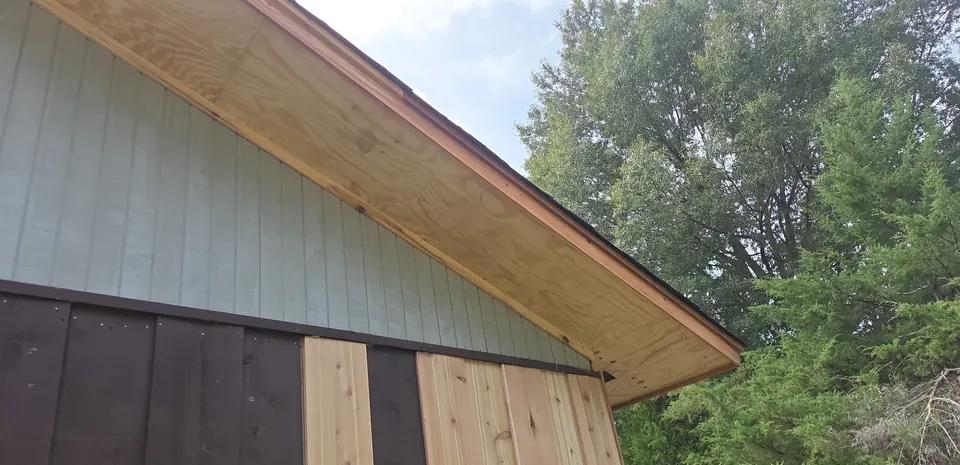
Soffit vents are the openings in the panels under your roof overhang that let outside air into the attic. They are the intake half of attic ventilation: cooler air comes in low at the soffits, rises through the attic, and leaves high through a ridge vent, turbines or a fan. If the soffit vents are missing, painted over or buried in insulation, the exhaust vents at the top have almost nothing to pull from, and the attic stays hot in summer and damp in winter no matter how many vents are on the roof.
We are Patriot Roofing and Restoration in Maumelle, and we check ventilation on every roof we inspect across Central Arkansas. This post explains the kinds of soffit vents, how much intake a house needs, and the problems we see most often. Product figures come from Lomanco's and Atlas's own pages, checked November 8, 2026.
Where soffit vents are and how they work
The soffit is the flat panel on the underside of the overhang, running from the bottom of the fascia board back to the wall. On a vented soffit, air passes through that panel into the space at the lower end of the rafters and up into the attic. Warm air rises, so as heat and moisture leave through the exhaust vents near the ridge, fresh air is drawn in at the eaves to replace it. That steady flow is what keeps the attic close to outdoor temperature.
Lomanco, a vent maker, puts it bluntly: "Inadequate intake is the #1 cause of attic ventilation system failure." A ridge vent with no intake under it is like a chimney with the bottom bricked up.
Types of soffit vents
- Continuous strip vents. A long, narrow vent that runs along the soffit. Lomanco sells its continuous soffit vents in 8-foot sections that can be cut at 2-foot intervals.
- Vented soffit panels. Vinyl or metal soffit with perforations built into the panel. Lomanco says that with vinyl or metal under-eave panels, "the vented panels should be installed continuously around the under eave portion of the house."
- Individual rectangular vents. Louvered vents set into cutouts in a solid wood or plywood soffit, common on older Central Arkansas homes. Lomanco calls its version cornice vents.
- Round plug vents. Small circular vents pushed into drilled holes. They move far less air than strip vents. Lomanco lists its 8-inch round vent at 13 square inches of net free area each.
- Roof-edge intake for homes with no overhang. When there is little or no soffit, intake can go on the roof deck instead. Atlas says its HighPoint Intake Eave Vent is "designed to add intake to homes without soffits" and is installed on the roof deck above the insulation line, at 9 square inches of net free area per foot (Atlas data sheet ATL-246737-00, January 2024). Lomanco makes similar products, its Deck-Air and SV-10 drip edge vents.
One thing never to do, in Lomanco's words: "never use an exhaust louver as an intake vent." Intake and exhaust vents are built for different jobs.
How many soffit vents does a house need?
Vent area is measured as net free area (NFA), the actual open space air can pass through after screens and louvers. The International Residential Code, section R806.2, calls for at least 1 square foot of NFA for every 150 square feet of attic floor. That can drop to 1 for every 300 square feet when 40 to 50 percent of the vent area is up high, near the ridge, and the rest is low at the eaves or soffits. Atlas's ventilation instructions quote the same code and add that "soffit intake should equal ridge exhaust." Lomanco says the intake "must provide as much as or more than the exhaust system in Net Free Area." Either way, the intake should not come up short.
Here is how that works out on a 1,500 square foot attic using the 1/300 rule:
- 1,500 divided by 300 is 5 square feet of total NFA, or 720 square inches.
- About half of that, 360 square inches, should be intake at the soffits.
- With a continuous soffit vent rated at 88 square inches per 8-foot piece (Lomanco's Model 140, about 11 square inches per foot), that is roughly 33 feet of vent.
- With 8-inch round vents at 13 square inches each, it would take about 28 of them.
This is a simple illustration, not a design for your house. The real number depends on your attic floor area, the vents you already have and the exhaust you pair them with, which is why we measure before we recommend anything. Our attic ventilation page explains how we balance the two ends.
Why soffit vents stop working
- Insulation pushed against them. Blown-in insulation can pile up at the eaves and seal off the air path. Lomanco says proper vent chutes should be installed before blown-in insulation "to prevent choking your intake system," one between each set of rafter tails.
- Paint. Years of repainting a wood soffit can fill the louvers and screen.
- Too few, too small. A handful of round vents on a long eave often adds up to far less intake than the exhaust on the roof.
- Solid soffit with no vents at all. Some homes, and some soffit replacements, simply never had intake.
- Damage and pests. Rotted or sagging soffit, wasp nests and debris in the openings. Water from overflowing gutters is usually what rots the soffit in the first place.
Signs to look for: an upstairs that stays hot with the AC running, damp or matted insulation, rusty nail tips through the roof deck in the attic, and dark staining on the underside of the decking. Our post on ridge vents and attic ventilation in Arkansas heat covers the exhaust side.
Why intake matters on an Arkansas roof
Central Arkansas summers are hot and humid. A poorly vented attic holds that heat against the underside of the roof deck and the shingles and makes the air conditioner work harder. In winter, warm, damp air from the house rises into the attic, and without airflow it can condense on the cold roof deck. Both problems start with air that cannot get in at the bottom.
Intake matters with an exhaust fan too. On our solar attic fans page we note Attic Breeze's rule that a fan needs at least as much intake area as it is rated to exhaust, usually through soffit vents. And we do not mix exhaust types that fight each other, such as a powered fan beside a ridge vent, because one can pull air in through the other instead of from the soffits.
How Patriot handles soffit vents
- Every inspection. Ventilation, intake included, is part of our 21-point roof inspection with attic analysis. The ventilation check is free with a storm or replacement inspection. A repair diagnostic visit is $79.99 and includes the 21-point inspection; Patriot Care Club members pay no service fee.
- Every new roof. Ventilation comes with each roof replacement package: balanced ridge and intake ventilation on Guardian and Defender, balanced metal-compatible ventilation on Armor, and whirlybird ventilation on Shield. See what else is included on our roof replacement page.
- Soffit repair and replacement. We repair and replace soffit on its own or with new gutters, siding or a roof, and price it in writing after we measure. New soffit and fascia carry a 5-year Patriot Built Right Guarantee, and soffit and fascia repairs carry a 365-Day Patriot Built Right Guarantee. Our soffit and fascia page has the details.
Frequently asked questions
Do soffit vents need to go all the way around the house?
Not always, but intake should be spread along the eaves under the attic so air reaches the whole space, not bunched in one corner. With vinyl or metal soffit, Lomanco recommends running the vented panels continuously around the eaves.
Can you add soffit vents to a solid soffit?
Usually, yes. Vents can be cut into a solid wood soffit, or the soffit can be replaced with vented panels. We also check from the attic that insulation will not block the new openings.
Can you have too many soffit vents?
Short intake is the common problem. Atlas says soffit intake should equal ridge exhaust, and Lomanco says intake should be at least as much as exhaust. What matters is that the two are balanced and sized to the attic.
Should soffit vents be covered in winter?
No. In winter the airflow carries moisture out of the attic before it can condense on the roof deck. Covering the intake traps it.
What if my house has no soffit overhang?
Intake can be added at the roof edge with a deck-mounted vent, such as Atlas's HighPoint Intake Eave Vent, usually during a roof replacement.
Not sure your attic is breathing?
If your soffit vents are painted over, blocked or missing, or your upstairs never cools off, we are glad to take a look. Contact us for a free storm or replacement inspection with a 21-point report and photos, or to book a repair visit.
21-Point Roof Inspection
Your Roofing Specialist checks the roof and attic and gives you a 21-point report with photos of what we find.
Roof Repair Diagnostic Visit
Includes the 21-Point Roof Inspection Report and attic analysis. Patriot Care Club members pay no service fee.