
Rake vs Eave: The Two Roof Edges and Why They Matter
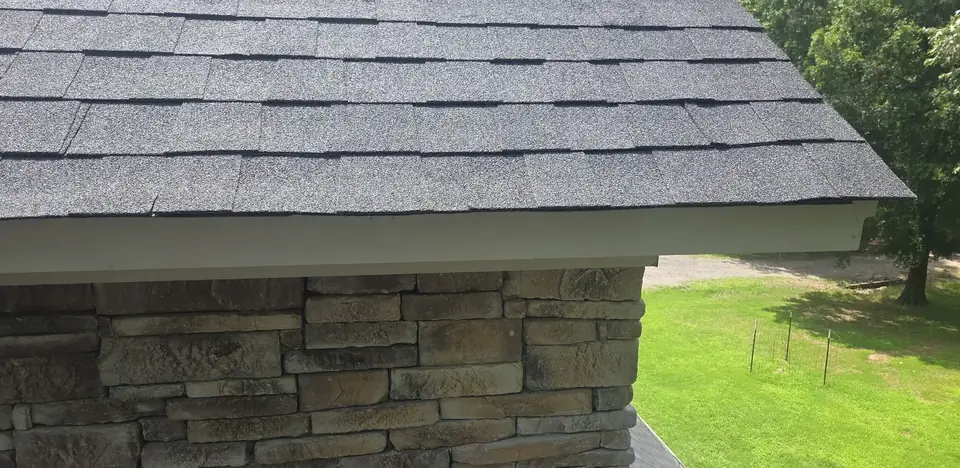
The eave and the rake are the two kinds of edge on a sloped roof. An eave is a level edge at the bottom of a roof slope, where rainwater runs off and where gutters hang. A rake is a sloped edge that runs up the side of a gable end, from the eave to the ridge. Water leaves the roof at the eaves; wind catches the roof at the rakes. That is why a good roofer finishes the two edges differently, and why the words show up on estimates and inspection reports.
Rake vs eave at a glance
| Eave | Rake | |
|---|---|---|
| Where it is | The lower edge of a roof slope | The sloped side edge at a gable end |
| Direction | Level, parallel to the ground | Runs uphill from the eave to the ridge |
| What it handles | All the water coming off that slope | Wind and wind-driven rain along the side |
| Gutters | Yes, gutters hang here | No |
| Trim board behind it | Fascia, with soffit underneath | Rake board (also called a barge board or rake fascia) |
| Drip edge and underlayment | Drip edge goes under the underlayment | Drip edge goes over the underlayment |
| Typical trouble | Rotted fascia and deck edge, water behind the gutter, ice dams | Shingles lifting or tearing off at the corners after wind |
How to tell which edge you are looking at
Stand in the yard and follow the edge of the roof with your eye. If the edge stays level and a gutter could hang on it, it is an eave. If the edge climbs at an angle toward the peak, it is a rake.
- Gable roofs have both: eaves along the front and back, and a rake on each side of every triangle-shaped gable end. Our guide to the gable roof walks through the other parts.
- Hip roofs slope down on all four sides, so a simple hip roof has eaves all the way around and no rakes. The sloped lines on a hip roof are hips, which are ridges, not edges.
- Mixed roofs, very common around Central Arkansas, have a hip main roof with gables over the garage, a porch or a dormer. Each of those small gables adds a pair of short rakes. Not sure which you have? See hip roof vs gable roof.
What happens at the eaves
Every drop of rain that lands on a slope ends up at its eave, so the eave is built to move water out and away. Here is what is stacked along a well-built eave, from the wood out:
- Drip edge under the underlayment. The International Code Council's guide to the 2012 International Residential Code says underlayment must lap over the drip edge at the eaves. That way water running down the underlayment lands on the metal and drips off, instead of slipping behind it. Atlas gives the same order in its Pinnacle Impact instructions: drip edge "beneath the underlayment at the eaves."
- Starter shingles with the seal at the edge. Atlas says to overhang its starter shingle 1/4 to 3/4 inch past the eave and that the sealant line "should always be positioned along eave," so the first row of shingles is glued down right at the edge. More in our post on starter shingles.
- Ice and water protection where it is called for. Atlas says eave and rake waterproof flashings must be installed per local building codes where icing is possible. Ice dams are rare in Central Arkansas but they do happen after winter storms; see ice and water shield on an Arkansas roof.
- Fascia, soffit and gutter. The fascia board holds the gutter, and the soffit underneath is usually where the attic takes in fresh air for the ridge vent. Our soffit and fascia guide covers both.
Signs of an eave problem: stains or soft spots on the fascia, water spilling behind the gutter, a sagging gutter, or dark, rotted wood along the bottom of the roof deck when you look from the attic.
What happens at the rakes
A rake has no gutter and carries little water, but it sits right where wind wraps around the house. On a gable home, the rake corners are usually the first place shingles lift or blow off after a strong storm. The details there are about holding the edge down and covering the deck edge:
- Drip edge over the underlayment. The International Code Council's guide says the drip edge must be installed over the underlayment along the rakes, the reverse of the eave. Atlas says the same: drip edge "over the underlayment at the rake." The code also calls for drip edge at both eaves and gables of shingle roofs, overlapped at least 2 inches and fastened no more than 12 inches apart.
- A sealed rake edge. Atlas's starter instructions are headed "Starter Course (Eave and Rake)," and its Pinnacle Impact instructions allow an optional band of asphalt plastic cement along the rake to hold the edge shingles down.
- Rake trim. The rake board behind the edge is exposed to sun and rain on its face, so it rots and peels in the same way fascia does.
Signs of a rake problem: shingles missing or flapping along the side edges, especially at the bottom and top corners; shingle edges that hang past the rake with nothing under them; and peeling paint or soft wood on the rake board.
Words you will see on an estimate
- Eave: the level lower edge of a slope.
- Rake: the sloped side edge at a gable end.
- Overhang: the part of the roof that sticks out past the wall, at both eaves and rakes.
- Fascia: the trim board on the face of the eave that the gutter attaches to.
- Soffit: the underside of the eave overhang, often vented.
- Drip edge: the metal edge trim at eaves and rakes. See what drip edge is.
- Linear feet of eave and rake: measurement reports list them separately, because starter, drip edge and gutters are ordered by the foot of edge.
What Patriot does at both edges on a new roof
Every Patriot Roofing and Restoration roof replacement starts with a tear-off down to the decking, so we can see the deck edge at every eave and rake. The decking is checked, the first 2 sheets of replacement decking are included, and any rot we find is photographed and priced in writing before it is repaired. Then the edges are finished to the package you choose:
- Armor (metal): color-matched metal drip edge, eave and trim starter system, and ice and water shield at valleys and penetrations.
- Shield Plus: aluminum drip edge, eave and rake starter strips, and ice and water shield at valleys and penetrations.
- Shield: aluminum drip edge, eave and rake starter strips, and ice and water shield at valleys and penetrations.
- Economy: galvanized drip edge, eave starter strips, and ice and water shield at valleys.
Drip edge goes on the full perimeter, eaves and rakes, on every package. Each new roof is backed by a Patriot Leak Free Guarantee of up to 15 years: Armor 15 years, Shield Plus 15 years, Shield 10 years and Economy 5 years.
Fixing just an edge
If the rest of the roof is sound, an edge can often be repaired on its own. Missing drip edge can be added by lifting the first row of shingles, sliding the metal in and sealing the shingles back down. Our price book lists new metal drip edge along up to 50 feet of roof edge at $786 on a standard-pitch roof; every line is on our roof repair prices page. Repairs carry the 365-Day Patriot Leak Free Guarantee.
Frequently asked questions
Is a rake the same as a gable?
No. The gable is the triangle-shaped end of the house. The rakes are the two sloped roof edges along the top of that triangle.
Do gutters ever go on rakes?
No. Gutters need a level edge to carry water to a downspout, so they hang on eaves. Water that runs off a rake is minimal, because rain flows down the slope toward the eaves.
Does a hip roof have rakes?
A simple hip roof does not. Every edge is an eave. Rakes only appear where the roof has a gable, such as over a garage, porch or dormer.
Why does drip edge go under the underlayment at the eave but over it at the rake?
At the eave, water running down the underlayment needs to land on top of the metal so it drips off. At the rake, the metal covers the underlayment edge so wind-driven rain cannot get under it. Both the International Residential Code and Atlas's instructions call for this order.
Which edge fails first?
It depends on the problem. Water damage, such as rotted fascia and deck edges, shows up at the eaves. Wind damage on gable homes usually starts at the rake corners.
Want us to look at your roof edges?
If you see shingles lifting at the rakes or stains along your fascia, contact us. Repair diagnostic visits are $79.99, and Patriot Care Club members pay no service fee. After a hail or wind storm, or if you are pricing a new roof, ask for a free storm or replacement inspection with our 21-Point Roof Inspection Report and photos.
Sources, checked November 18, 2026: International Code Council, 2012 IRC Significant Changes, section R905.2.8.5 Drip Edge; Atlas Roofing, Pinnacle Impact General Instructions; Atlas Roofing, Pro-Cut Universal Starter Application Instructions.
21-Point Roof Inspection
Your Roofing Specialist checks the roof and attic and gives you a 21-point report with photos of what we find.
Roof Repair Diagnostic Visit
Includes the 21-Point Roof Inspection Report and attic analysis. Patriot Care Club members pay no service fee.