
What Does Hail Damage Look Like on a Roof? A Homeowner's Field Guide
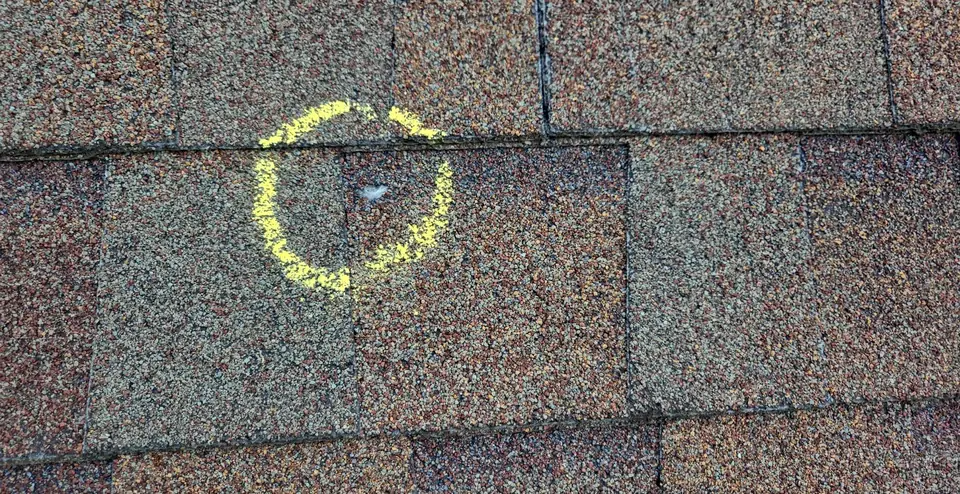
Hail damage on an asphalt shingle roof looks like scattered dark spots where the granules have been knocked off, often with a soft, bruised feel when pressed, and sometimes a crack or a shiny patch of bare asphalt in the middle. The hits fall in a random pattern, not in lines or along edges, and they usually show up alongside dents and spatter marks on gutters, vents and other metal around the house. From the driveway, a hail-damaged roof often looks perfectly normal, which is why the rest of the house is the best place to start looking.
This guide walks you through what to look for, in the order we look for it, without climbing a ladder. For how hail actually breaks down a shingle and how insurers treat it, see how hail damages asphalt shingles and cosmetic vs functional hail damage.
Start on the ground: the rest of the house tells the story
The Insurance Institute for Business and Home Safety (IBHS) points homeowners to what it calls collateral damage: dents and spatter marks on air conditioning units, gutters, metal flashing and downspouts. IBHS says collateral damage "confirms a hail event occurred, which helps distinguish hail damage from normal wear and tear." You can check all of it safely from the yard.
- Gutters and downspouts. Look along the top front edge of the gutter and down the face of each downspout for small round dents. Sun hitting the metal at a low angle makes them easier to see.
- The air conditioner. Thin aluminum fins on the outdoor unit flatten easily. A patch of crushed fins on the side that faced the storm is a strong clue.
- Spatter marks. Hail knocks the dirt and oxidation off painted metal, mailboxes, fences, grills and the top of the AC unit, leaving fresh round marks. Weather wears them away over time, so photograph them early.
- Window screens and soft siding. Torn or dimpled screens and cracked or punctured vinyl siding, usually on one or two sides of the house.
- Painted trim and wood. Small round chips in paint on fascia, window trim, decks and fences.
- Cars, patio furniture and plants. Shredded leaves and dented outdoor furniture help show how big the hail was and which way it came from.
Dents on the gutters do not prove the shingles were damaged, and a clean gutter does not prove they were not. Collateral damage tells you hail fell at your house and roughly how big it was. Only a close look at the roof tells you what it did to the shingles.
Hail size: what the National Weather Service uses
The National Weather Service classes a thunderstorm as severe when it produces hail one inch in diameter or larger, or winds of 58 mph or more. Its hail size guide uses everyday objects for reports: penny 0.75 inch, nickel 0.88 inch, quarter 1.00 inch, ping pong ball 1.50 inches, golf ball 1.75 inches, hen egg 2.00 inches. If you saw hail, comparing it to one of these is the most useful thing you can tell a roofer or your insurer.
Smaller hail still matters. IBHS testing of high concentrations of sub-severe hail (under one inch) found that small hail knocks granules off asphalt shingles and speeds up aging, and that shingles with natural weathering plus two rounds of small hail became up to ten times more susceptible to damage from later large hail than new shingles.
What hail damage looks like on the roof itself
Asphalt shingles
IBHS lists a random pattern of impact marks, bruising ("soft spots you can feel when pressing on the shingle") and cracks or breaks where hail struck. Travelers, in its own homeowner guide, adds hits that look black, granule loss that can expose the mat, asphalt that looks shiny, and hits that are "soft to the touch, like the bruise on an apple." In practice that means:
- Round or irregular dark spots, roughly the size of the hailstones, where granules are missing.
- A soft spot under some of them, because the fiberglass mat underneath has been fractured.
- Granules piled in the gutters and at the bottom of downspouts right after the storm.
- More hits on the slopes that faced the storm than on the sheltered ones.
- Damage on the ridge cap. IBHS notes that "ridge caps are especially vulnerable on an asphalt shingle roof."
On an inspection, our specialists circle each hit in chalk so it shows clearly in the photographs, like the bruised shingle in the photo at the top of this page.
Metal roofs
On a steel panel roof, hail leaves round dents. Whether a dent matters depends on whether the coating cracked or the panel or a seam opened up, and many policies treat purely cosmetic dents on metal differently from damage that lets water in, so check the wording of yours. Our Armor package uses a 26-gauge steel panel rated for hail up to 2 inches.
Vents, flashing and skylights
Ridge vents, turbines, box vents, pipe boots and metal flashing take dents and cracks the same way gutters do, and a cracked plastic vent or pipe boot can leak before any shingle does. These are part of every roof inspection we do.
Things that look like hail damage but are not
IBHS names several look-alikes: granule loss along shingle edges from natural weathering, uniform wear or discoloration, manufacturer defects, marks from installation or tools, and granules washed off by heavy rain. Travelers adds that normal aging and brittleness from sun and weather can be mistaken for hail. Here is how they usually compare.
| What you see | Hail | Usually something else |
|---|---|---|
| Pattern | Random, spread across a slope, heavier on the storm side | Lines, edges only, or one spot where someone walked or worked |
| Granule loss | Round or irregular spots about the size of the hail | Even thinning across the whole roof (age) or along the edges (weathering) |
| Feel | Soft or spongy under the spot | Firm, or a raised bubble (a blister) |
| Metal around the house | Fresh dents and spatter marks on the same side | No collateral marks anywhere |
| Timing | Appeared right after a storm, granules in the gutters | Developed slowly over years |
None of these tests is final on its own. That is why an inspector looks at the whole roof, every slope, and the metal around it before calling anything hail damage.
Please do not climb the roof
A wet or steep roof is no place to check for hail, and a fall is far more costly than any roof repair. Everything above the gutter line is our job. From the ground, take photos and notes, and leave the roof to a professional.
What to photograph after a hail storm
- The hailstones themselves next to a coin or a ruler, if you can do it safely.
- Dents on gutters, downspouts and the AC unit, close up and from a few steps back.
- Spatter marks on painted metal and fences, before they fade.
- Torn screens, cracked siding and chipped paint.
- Any water stains inside, and the attic if you can reach it safely.
- The date of the storm. If you are not sure of the exact date, do not guess; say you are not sure.
How we inspect for hail
Patriot Roofing and Restoration does free storm inspections across Central Arkansas, and each one comes with a 21-point report and photos of what we found. If the damage looks like a claim, we explain what we found and you decide whether to file. If you do, we can meet your insurance adjuster at the house and walk the roof with them so nothing gets missed. The coverage decision is always your insurance company's. Our storm claim checklist walks you through the first steps.
If water is already coming in, call 501.441.2900. Our phones are answered live 24/7, and we can tarp the roof to stop the water. Keep the tarping receipt for your insurer.
If you want a photo record of your roof before the next storm, the Patriot Care Club includes a yearly 21-point roof checkup with photos you can reach any time.
This is general information, not insurance advice. Coverage, deductibles and deadlines vary by policy and carrier, so confirm the details with your agent.
Frequently asked questions
Can you see hail damage on a roof from the ground?
Usually not. Most hail hits on shingles are too small to see from the yard. Dents and spatter marks on gutters, downspouts and the air conditioner are the best clues you can see from the ground.
Does hail damage show up right away?
The marks are there right away, but a bruised shingle may not leak for months. Spatter marks on metal wear away with weather, so it pays to look and take photos soon after the storm.
What size hail damages a roof?
The National Weather Service treats one inch (quarter size) and larger as severe hail. IBHS testing found that repeated smaller hail can also knock granules off shingles and leave them far more vulnerable to the next large hail.
Is granule loss always hail damage?
No. Shingles shed some granules as they age, and heavy rain can wash granules off. IBHS lists edge wear and uniform wear as weathering, not hail. Round spots with a soft feel, in a random pattern, right after a storm, point to hail.
Do dented gutters mean my roof needs replacing?
Not on their own. They show that hail fell at your house. Whether the roof needs a repair, a replacement or nothing at all depends on what an inspection finds on each slope.
Is a hail inspection free?
Yes. Patriot Roofing and Restoration does not charge for hail, wind and storm damage inspections, and each one includes a 21-point report with photos.
Think hail hit your roof?
We will look at the roof, the gutters and the rest of the house and show you, with photos, what the storm did. Learn more about our storm damage repair, or contact us to schedule a free storm inspection.
21-Point Roof Inspection
Your Roofing Specialist checks the roof and attic and gives you a 21-point report with photos of what we find.
Roof Repair Diagnostic Visit
Includes the 21-Point Roof Inspection Report and attic analysis. Patriot Care Club members pay no service fee.