
Roofing Nails: What Size, How Many per Shingle and Where They Go
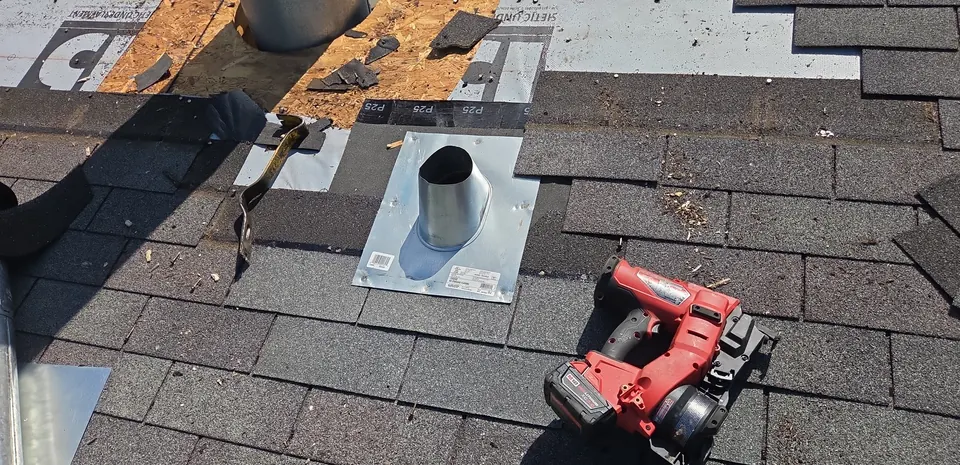
Asphalt shingles go on with roofing nails: corrosion-resistant nails with a 3/8 inch head, an 11 or 12 gauge shank and enough length to sink at least 3/4 inch into the roof deck, which usually means 1-1/4 inch nails on a new roof. Most architectural shingles take 4 nails each, 6 on steep slopes and mansards, placed in the nailing line the manufacturer marks on the shingle. Getting the nails right matters as much as picking the shingle, because a wrongly placed or overdriven nail is one of the few installation mistakes that can void a shingle's wind coverage.
We are Patriot Roofing and Restoration in Maumelle, and we replace and repair roofs across Central Arkansas. Atlas is our primary shingle line, so this post uses Atlas's own installation instructions and the Asphalt Roofing Manufacturers Association (ARMA) technical bulletin on nailing, both checked November 7, 2026. Always follow the instructions printed on the wrapper of the exact shingle on your roof.
What size roofing nails do shingles need?
ARMA's bulletin "Nail Application of Asphalt Strip Shingles for New and Recover Roofing" (July 2024) and Atlas's instructions agree on the basics:
- Shank: ARMA calls for a minimum nominal shank diameter of 12 gauge (0.105 inch). Atlas allows 11 or 12 gauge. A lower gauge number means a thicker nail.
- Head: at least 3/8 inch across. The wide, flat head is what holds the shingle down, so a smaller-headed nail is not a substitute.
- Material: ARMA says roofing nails must be corrosion-resistant galvanized steel, stainless steel, aluminum or copper. Atlas simply says corrosion-resistant roofing nails.
- Length: Atlas says nails must be at least 1-1/4 inches long, and it recommends 2 inch nails when shingles are laid over an existing roof.
- Deck penetration: both say the nail must go at least 3/4 inch into the deck. If the deck is thinner than 3/4 inch, the nail has to go all the way through and stick out at least 1/8 inch underneath.
That last rule is why the right length depends on the roof. The nail has to pass through every layer above the deck first, so anywhere it goes through more material, such as a roof-over, a longer nail is needed to meet the same penetration rule.
How many nails per shingle?
For standard installations, Atlas's Pinnacle Pristine and ProLam instructions both say 4 nails are required per shingle, and ARMA says most asphalt strip shingles need a minimum of four. Atlas adds that steep slope and mansard applications require 6 nails evenly spaced along each shingle.
Wind ratings are tied to the nail count. Atlas's Pinnacle Pristine instructions list wind gusts up to 130 mph with the standard 4-nail installation for shingles built with HP42 Technology. Atlas's ProLam instructions list gusts up to 110 mph with 4 nails and point to the Atlas Limited Warranty's high-wind provisions for 130 mph, which call for 6 nails. If you want the higher wind rating on a ProLam roof, ask your roofer to confirm the nail count in writing.
A rough count for a full roof: Atlas Pinnacle and ProLam shingles are 42 by 14 inches with a 6 inch exposure, and we cover how many fit in a square in our post on bundles of shingles per square. At about three bundles per square, and Atlas's 18 to 20 shingles per bundle, that works out to roughly 220 to 240 field nails per square at 4 nails each, plus nails for the starter course and the hip and ridge.
Where the nails go
Placement is where most nailing mistakes happen. Atlas's instructions put the nails 7 inches up from the bottom edge of the shingle, with one nail about 1 inch in from each end, and say nails may be placed in the sealant line. ARMA says no nail head should be closer than 1 inch to either end, and that nails should never land where they will show on the finished roof.
- High nailing. Atlas warns that nails placed too high "can result in separation of components and will cause delamination of the shingles after application." That is why the nailing line matters so much on a laminated shingle.
- Exposed nails. A nail that shows on the finished roof lets water follow it into the deck. Atlas says nails must not be exposed.
- Bad spots in the deck. ARMA says not to drive nails into knot holes, cracks or gaps in the roof deck, because they will not hold.
- Starter and ridge. Atlas nails its starter course about 3 inches up from the eave with 4 nails, and its hip and ridge shingles with two nails each, 6 inches back from the exposed end and 1 inch up from the edge.
Atlas states it plainly: incorrectly placed nails will void the wind coverage of the warranty.
Overdriven, underdriven and crooked nails
Many roofers use pneumatic coil nailers. Atlas says either a hammer or a properly adjusted nailer is fine, and that a badly adjusted gun can cause "nail corrosion, sealing failures, raised tabs, buckling and blow offs." The nail head should sit snug and flush against the shingle, never cutting into it.
- Underdriven nails stand proud of the shingle. Atlas lists sealing failures and raised tabs among the results of bad nailer adjustment. ARMA and Atlas both say they can be tapped down until snug.
- Overdriven nails sink into or break through the shingle mat, so the head no longer holds it. ARMA and Atlas say to remove them, patch the hole with asphalt roof cement that meets ASTM D4586, and nail again nearby, or replace the shingle.
- Crooked nails get the same treatment as overdriven ones, because the edge of the head cuts the shingle.
Nailing problems can also make a new roof look uneven. If you are seeing ridges or ripples in a roof that is only a few months old, our post on why a new roof looks wavy covers the usual causes.
Cap nails, coil nails and other fasteners on a roof
Shingle nails are only one of the fasteners on a roof:
- Coil nails are standard roofing nails collated on a wire or plastic coil for a pneumatic nailer. They hold the starter, field shingles and hip and ridge.
- Cap nails have a wide plastic or metal washer under the head and hold synthetic underlayment to the deck before the shingles go on. Atlas's synthetic underlayment video explains why plastic cap fasteners are preferred over staples, and warns against pulling the underlayment too tight. Our post on synthetic vs felt underlayment covers the underlayment itself.
- Metal roof fasteners are a different system entirely. Panels such as our Armor 26-gauge PBR steel roof are fastened according to the panel maker's specifications, not with shingle nails.
On every Patriot roof replacement, coil nails, cap nails and sealant are included in the price, along with tear-off down to the decking, starter shingles on the eaves and rakes, synthetic underlayment, drip edge on the full perimeter and hip and ridge. The full list is on our roof replacement page.
Why the deck matters as much as the nail
A nail is only as good as the wood it goes into. Rotted or delaminated decking will not hold nails properly, which is one reason we tear off the old roof instead of laying new shingles over it: tear-off is the only way to check the decking. The first 2 sheets of decking are included with every replacement, and replacing more is $100 a sheet installed. Our post on finding rotted decking at tear-off explains how that works.
Exposed nails and nail pops on an older roof
On an existing roof, a nail that has backed out and lifted the shingle above it, or a nail head left bare at a ridge or flashing, is a small opening for water. These are common things to find on an inspection, and they are usually a repair rather than a reason to replace the roof. A roof repair visit is $79.99 for non-members (no service fee for Patriot Care Club members) and includes our 21-point roof inspection, and once all recommended repairs are done they carry the 365-Day Patriot Leak Free Guarantee.
Frequently asked questions
What size nails do you use for roof shingles?
Corrosion-resistant roofing nails with an 11 or 12 gauge shank and a head at least 3/8 inch across, long enough to go 3/4 inch into the deck or all the way through a thinner deck. Atlas sets a minimum length of 1-1/4 inches and recommends 2 inches for a roof-over.
How many nails go in each shingle?
Four on a standard Atlas installation, and six on steep slopes and mansards. Some wind warranties also call for six, so check the warranty for the shingle on your roof.
Can roofing staples be used instead of nails?
Neither Atlas's shingle instructions nor ARMA's nailing bulletin lists staples as a shingle fastener; both specify roofing nails. For underlayment, Atlas prefers plastic cap fasteners over staples.
Are roofing nails galvanized?
Many are galvanized steel. ARMA allows galvanized steel, stainless steel, aluminum or copper, as long as the nail is corrosion-resistant.
Can a nailing mistake void my shingle warranty?
It can affect it. Atlas says incorrectly placed nails will void the wind coverage of its warranty. Ask your roofer which shingle, nail count and warranty you are getting, and get it in writing.
Get it nailed right
If you are comparing roof quotes and want to know how your new roof will be fastened, or you have spotted exposed nails on your current roof, we are glad to take a look. Contact us for a free storm or replacement inspection with a 21-point report and photos, or to book a repair visit.
21-Point Roof Inspection
Your Roofing Specialist checks the roof and attic and gives you a 21-point report with photos of what we find.
Roof Repair Diagnostic Visit
Includes the 21-Point Roof Inspection Report and attic analysis. Patriot Care Club members pay no service fee.