
Sagging Gutters: Why They Pull Away and How to Fix Them
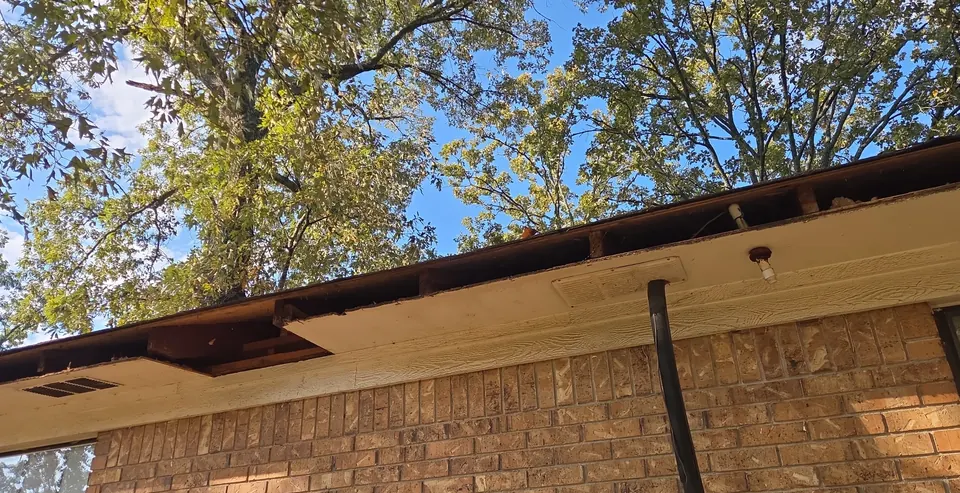
A sagging gutter is almost always a support problem: the hangers holding the gutter have loosened, spread too far apart or lost their grip because the fascia board behind them has gone soft. The weight of standing water, wet leaves and debris then pulls that section down. The fix is to clean the gutter, re-fasten it with new hangers at closer spacing into solid wood, and set the pitch so water runs to the downspout again. If the fascia has rotted, the board has to be repaired first, or new hangers will pull out the same way. A gutter that is bent, split or sagging along most of its length is usually better replaced than re-hung.
Here is why gutters sag, how to tell which cause you have from the ground, when a re-hang is enough, and when it is time for new gutters.
Why gutters sag
A gutter hangs on supports fastened to the fascia, the board along the edge of the roof. A clean, empty aluminum gutter is light. A gutter full of water and wet leaves is not, and every hard rain puts that load on the same few fasteners. A section sags when one of these gives way:
- Hangers too far apart. The University of Illinois Building Research Council's guide Gutters and Downspouts for the Home says "the maximum spacing of supports for aluminum and copper gutters should be 32 inches." Older installs often stretched further than that, and the gutter bends between supports.
- Fasteners that have backed out. Older gutters were often hung with long spikes driven through the gutter into the fascia. Over years of heating, cooling and loading, spikes work loose and the gutter drops away from the house.
- Soft or rotted fascia. A fastener is only as strong as the wood it is in. When water gets behind the gutter, the fascia rots and the screws or spikes lose their hold. This is the cause most often hidden until the gutter comes down.
- Clogs and standing water. Debris holds water in the gutter, and the extra weight pulls on the hangers. Once a section dips, water and debris collect in the low spot and make it worse.
- Something leaning on it. A ladder set against the gutter, a falling limb or sliding debris after a storm can bend a run or tear a hanger loose.
Read the sag: what you can see from the ground
You can learn a lot without climbing anything. Stand at each end of the gutter line and sight down it, then match what you see to this table.
| What you see | Most likely cause | Usual fix |
|---|---|---|
| One short dip between two supports | Hangers spaced too far apart, or one hanger has failed | Add or replace hangers, re-pitch the run |
| A gap between the back of the gutter and the fascia | Spikes or screws backing out | Re-fasten with new hangers into solid wood |
| Gutter pulled away, with dark, peeling or crumbling wood behind it | Rotted fascia that can no longer hold a fastener | Repair the fascia, then re-hang the gutter |
| Water stands in the low spot a day after rain | The sag has reversed the pitch | Clean, re-hang and re-pitch toward the downspout |
| A wavy line along the whole run | Worn supports throughout, or a bent gutter | Usually new seamless gutters |
| A kink or crease at one spot after a storm | Impact from a limb or debris | Replace the damaged section or run |
Also look below the sag. Splash marks on siding, washed-out mulch or a muddy line in the soil under one spot all point to water leaving the gutter where it should not.
Why a sagging gutter is worth fixing soon
A sag rarely stays the same size. The low spot holds water and debris, the added weight pulls harder on the hangers next to it, and the run drops further. Meanwhile, the water it misses goes where you do not want it:
- Into the fascia. Water that spills behind a gutter soaks the board the gutter hangs on, which loosens more fasteners. Read what a fascia board is and why it rots.
- Over the front. A sag that holds water is one of the most common reasons gutters spill in a hard rain; see why gutters overflow and how to tell the cause.
- Down to the foundation. Water that falls off the eave lands next to the house instead of going out through the downspout.
The Building Research Council's guide advises checking "for sags in the gutter where sections may be pulling away from the fascia" and inspecting the gutter system "at least twice a year," in spring and fall. Catching a sag at the first loose hanger is usually a small repair. Waiting until the fascia rots makes it a bigger one.
How a sagging gutter is fixed
A proper re-hang follows the same steps whether the sag is two feet long or twenty:
- Empty the gutter. Clear the debris and standing water so the gutter can be lifted back into position and the true condition is visible.
- Check the wood. Each fastening point is probed. A hanger driven into soft wood will fail again, so rotted fascia is repaired before anything is re-hung.
- Replace the supports. Old spikes and loose hangers come out. New hangers go in at closer spacing, within the 32 inch maximum for aluminum gutters that the Building Research Council gives, and are screwed into solid wood. The council notes that brackets are "secured to the fascia board or nailers by two fasteners."
- Reset the pitch. The run is set to fall toward its downspout. The U.S. Department of Energy's Building America Solution Center says to install gutters so they "slope at least 1/16 inch per foot of run," and the Building Research Council's simple test is that "water should not remain standing in the gutter."
- Reseal and test. Corners and end caps loosened by the sag are resealed, the downspout is cleared, and water is run through the gutter to confirm it drains.
A word on the do-it-yourself route: re-hanging a gutter means working at the roof edge from a ladder, often lifting a run full of wet debris. On a two-story home, a steep lot or anything wet, leave it to a crew with the right equipment.
Re-hang or replace?
Many sagging gutters only need new supports. Replacement makes more sense when:
- The sag runs along most of the gutter, not one section.
- The gutter itself is bent, creased or split, so it will not hold a straight line even with new hangers.
- Seams between sections leak as well as sag. Sectional gutters have a joint every length, and each one is a place to leak and flex.
- The gutters are undersized for the roof, so they overflow even when straight and clean.
- The fascia behind most of the run needs work anyway, so the gutters are coming down regardless.
Our Sentry seamless gutters are 5 or 6 inch aluminum, formed on site to the length of each run so the only joints are at the corners. They go up with hidden hangers and proper pitch, color-matched, with the old gutters hauled away. You can compare gutter types in Little Rock's top gutter styles.
How Patriot fixes sagging gutters
We start by finding out why the gutter dropped, because a missing hanger and a rotted fascia board are different repairs. Depending on what we find:
- Gutter repair. Re-hanging and re-pitching a sagging run, replacing loose supports, resealing corners and clearing downspouts, backed by our 365-Day Patriot Built Right Guarantee.
- Fascia repair. Rotted fascia is replaced so the gutter has solid wood to hold. Our preference when we replace fascia boards or hang gutters is to wrap the fascia in metal matched to your soffit color, because paint has to be redone later and a metal wrap protects the wood under the gutter far better. Soffit and fascia repairs carry a 365-Day Patriot Built Right Guarantee, and new soffit and fascia carry a 5-year Patriot Built Right Guarantee. See soffit and fascia repair.
- New seamless gutters. When the run is past saving, Sentry seamless gutters with a 5-year Patriot Built Right Guarantee. If rotted fascia turns up when the old gutters come off, it is photographed, priced in writing as a change order and approved by you before it is repaired.
- Gutter guards. Debris that sits in a gutter adds weight every time it rains. Guards keep it out: Armor stainless micro-mesh with a 5-year Patriot Built Right Guarantee, Guardian self-cleaning polypropylene with a 3-year Patriot Built Right Guarantee, or Shield perforated aluminum with a 1-year Patriot Built Right Guarantee. See gutter guards.
- Gutter cleaning. Standalone gutter cleaning is available, and Patriot Care Club members get 50% off gutter cleaning for up to 150 feet a year.
Gutters are priced by the foot, by size and by the protection you choose, and your written price comes at a free visit. For a quick number on new gutters first, try our gutter cost calculator. Learn more about our gutter installation and repair service.
Sagging gutters: quick answers
Can a sagging gutter be fixed, or does it need replacing?
Most sags can be fixed by cleaning the gutter, adding new hangers into solid wood and resetting the pitch. Replace the gutter when it is bent or split, sags along most of its length, or leaks at the seams as well.
How far apart should gutter hangers be?
The University of Illinois Building Research Council gives a maximum of 32 inches between supports for aluminum gutters, and closer spacing where ice and snow stay for much of the year.
Why does my gutter keep sagging after it was re-hung?
Usually the fascia behind it is soft, so new fasteners have nothing solid to grip. The rotted wood has to be repaired before the gutter will stay put.
Is a sagging gutter an emergency?
Not usually, but it gets worse with every heavy rain, and the water it spills can rot the fascia and soak the ground at the foundation. Have it looked at before the next storm season.
Do gutter guards make gutters sag?
Guards keep out the wet leaves and debris that weigh a gutter down. They should go on gutters that are sound, pitched to drain and fastened to solid fascia, so a loose gutter is re-fastened first, and any repairs are priced in writing before the guards go on.
Gutter pulling away from the house?
A sagging gutter is a small repair when it is caught early and a bigger one once the fascia behind it rots. Call Patriot Roofing and Restoration at 501.441.2900 or contact us online to have your gutters checked anywhere in Central Arkansas.
21-Point Roof Inspection
Your Roofing Specialist checks the roof and attic and gives you a 21-point report with photos of what we find.
Roof Repair Diagnostic Visit
Includes the 21-Point Roof Inspection Report and attic analysis. Patriot Care Club members pay no service fee.