
Why Are My Gutters Overflowing? Causes by Where the Water Spills
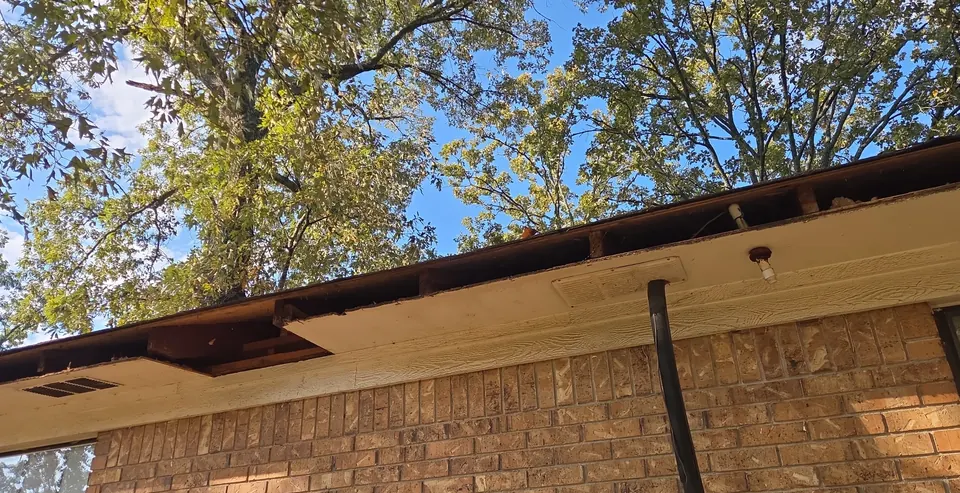
Gutters overflow when rain reaches them faster than the gutter and its downspouts can carry it away. The usual reasons are a clog in the gutter or downspout, a run that sags or slopes the wrong way, too few or too small downspouts for the roof above them, a gutter too small for the amount of roof draining into it, or a gutter hung so water misses it and runs down behind it. Where the water spills over tells you which one you have: water pouring over the front at one spot points to a clog or a low spot, water spilling along the whole run even when the gutter is clean points to too little capacity, and water dripping behind the gutter points to how the gutter meets the roof edge.
Here is how to read the spill, what each cause looks like, what you can check from the ground, and how each one is fixed.
Where the water spills tells you why
The best time to diagnose an overflowing gutter is during a hard rain, from the ground, with an umbrella. Watch where the water leaves the gutter and match it to this table.
| What you see in a hard rain | Most likely cause | Usual fix |
|---|---|---|
| Water pours over the front at one spot | A clog, a sag or a low spot holding water | Clean the gutter, re-hang or re-pitch the run |
| The gutter is full but little comes out of the downspout | A clogged downspout or elbow | Clear the downspout from the bottom up |
| Water sheets over the whole run, even right after cleaning | Too little capacity: the gutter is too small or there are too few downspouts | Add a downspout, use larger downspouts, or move up to a 6 inch gutter |
| Water shoots over an inside corner below a roof valley | A valley concentrates water and sends it in fast at one corner | More drainage near the corner, or a larger gutter on that run |
| Water runs down behind the gutter onto the fascia | Gutter hung too low, pulled away from the fascia, or missing drip edge at the roof edge | Re-hang the gutter, add drip edge, repair rotted fascia |
| Water spills where a lower roof meets a wall | Missing kick-out flashing at the bottom of the wall | Install kick-out flashing |
| Water stands in the gutter a day after the rain | The run is flat or slopes away from the downspout | Re-pitch the run toward the downspout |
Clogs in the gutter or the downspout
A clog is the most common cause and the easiest to spot. Leaves, pine needles, oak catkins, seed pods and shingle granules settle in the bottom of the gutter, and once they pack around the opening of a downspout, the gutter can only hold water until it spills. Downspouts clog too, most often at the elbows where the pipe turns. If the gutter fills in a storm but the downspout outlet only trickles, the blockage is in the downspout.
A clog that comes back every season is a sign of heavy tree cover rather than bad luck. That is where gutter guards help, because they let rain in and keep leaves and needles out. For more on keeping leaves out in fall, see how to prevent gutter clogs from falling leaves and debris.
A run that sags or slopes the wrong way
A gutter has to fall toward its downspout so water keeps moving. The U.S. Department of Energy's Building America Solution Center says to install gutters so they "slope at least 1/16 inch per foot of run." When a hanger pulls loose or the fascia behind it softens, a section drops and becomes a low spot. Water collects there, debris settles in it, and that is where the overflow starts.
Signs of a pitch problem: a gutter line that looks wavy from the street, standing water in the gutter a day after rain, and overflow at the same spot every storm. A sagging gutter is usually re-hung and re-pitched; if the board behind it has rotted, the board is repaired first so the hangers have solid wood to hold.
Too few or too small downspouts
If a clean, properly pitched gutter still overflows in a hard rain, the system does not have enough capacity for the roof area draining into it. The Building America Solution Center gives these guidelines:
- Gutters and downspouts should be "sized to accommodate anticipated water loads."
- Gutter channels are typically 4, 5 or 6 inches, and a larger size conducts more water "provided there are enough downspouts to drain the gutter channels."
- Downspouts should be placed "at least 20 feet apart but no more than 50 feet apart," and the closer they are, the more water the gutter can move in a peak storm.
- Allow "1 square inch of downspout cross-section for every 100 square feet of roof area."
That last point is why a long run with a single downspout at one end often overflows at the far end in a downpour. Adding a downspout, enlarging the downspouts or moving to a larger gutter on that run is the fix. Patriot's Sentry seamless gutters come in 5 inch and 6 inch; 6 inch gutters carry more water and suit larger or steeper roofs, and your specialist recommends a size based on your roof.
Valleys and steep roof sections
A roof valley is where two slopes meet, and it gathers water from both of them into one channel. In a hard rain that water reaches the gutter fast and in one place, usually at an inside corner, and it can shoot right over the front. Steep roofs do the same thing on a smaller scale because water runs off them faster. The cure is more drainage where the water lands: a downspout near the corner, a larger gutter on that run, or both. If the valley itself is worn, that is a roof problem to fix too; see roof valley leaks.
Water running behind the gutter
Water that drips down the back of the gutter is not really overflowing; it is missing the gutter. It runs off the roof edge, follows the underside of the shingles or the face of the fascia, and drops behind the gutter. Common causes are a gutter hung too low below the roof edge, a gutter that has pulled away from the fascia, and a roof edge with no drip edge. The Building America Solution Center's advice is simple: "If a drip edge is not present, install one." Drip edge is the metal trim along the roof edge that guides water into the gutter; you can read more in what is drip edge on a roof.
Where a lower roof runs into a wall, a small piece called kick-out flashing turns the water into the gutter. Without it, the solution center notes, high volumes of water can spill "over the gutter and running down the wall."
Why an overflowing gutter is worth fixing
A gutter that spills does more than make a curtain of water over the front door. The water it misses goes three places:
- The fascia and soffit. Water that runs behind the gutter soaks the fascia board the gutter hangs on, and the rot often stays hidden until the gutter comes down. See what a fascia board is and why it rots.
- The siding and walls. Spilled water splashes back onto siding and trim and runs down walls.
- The foundation. Water that falls straight off the eave lands next to the house. The solution center says downspouts "should terminate at least 5 feet from the foundation." For more, read how to prevent foundation damage from gutters in Arkansas clay soil.
What you can check from the ground
- Watch the gutters in a hard rain and note exactly where water leaves them.
- Check each downspout outlet during the rain. A strong flow is good; a trickle from a full gutter means a clog.
- Look down the gutter line from each end for waves or dips.
- After the rain, look for water stains, peeling paint or dark streaks on the fascia and siding behind the gutter.
- Look for washed-out soil, splash marks or standing water along the foundation below the spill.
Leave the ladder work to someone with the right equipment, especially on a two-story home or when anything is wet.
How Patriot fixes overflowing gutters
We start by finding which cause you have, because the fix for a clog is not the fix for an undersized system. Depending on what we find:
- Gutter cleaning. Standalone gutter cleaning is available, and Patriot Care Club members get 50% off gutter cleaning for up to 150 feet a year.
- Gutter repair. Re-hanging a sagging run, re-pitching, resealing corners and clearing downspouts, backed by our 365-Day Patriot Built Right Guarantee.
- Gutter guards. Three levels for heavy, moderate or light tree cover: Armor stainless micro-mesh with a 5-year Patriot Built Right Guarantee, Guardian self-cleaning polypropylene with a 3-year Patriot Built Right Guarantee, and Shield perforated aluminum with a 1-year Patriot Built Right Guarantee. See gutter guards.
- New seamless gutters. Our Sentry system is 5 or 6 inch seamless aluminum formed on site to the length of each run, with hidden hangers, proper pitch and color matching, and old gutters hauled away. It carries a 5-year Patriot Built Right Guarantee.
If rotted fascia is found when the old gutters come off, it is photographed, priced in writing as a change order and approved by you before it is repaired. Gutters are priced by the foot, by size and by the protection you choose, and your written price comes at a free visit. For a quick number first, try our gutter cost calculator. Learn more about our gutter installation and repair service.
Overflowing gutters: quick answers
Why do my gutters overflow when they are clean?
Clean gutters that still spill in a hard rain usually do not have enough capacity for the roof draining into them: too few downspouts, downspouts that are too small, or a gutter that is too small for the run. A sag that holds water in one spot can do it too.
Is it normal for gutters to overflow in very heavy rain?
A gutter that spills every time it rains hard has a problem worth fixing. Check for clogs and sags first, then look at downspout spacing and gutter size.
Will gutter guards stop my gutters from overflowing?
Guards stop overflow caused by leaves and debris. They do not add capacity, so if the gutter or downspouts are too small for the roof, the gutter can still overflow with guards on it.
Do bigger gutters stop overflowing?
Often, if capacity is the problem. A 6 inch gutter carries more water than a 5 inch gutter, but only when there are enough downspouts to drain it.
Why does water come out behind my gutter?
Water is getting past the gutter instead of into it, usually because the gutter hangs too low, has pulled away from the fascia, or the roof edge has no drip edge. Check the fascia behind it for rot.
Gutters spilling over?
Overflow is usually a simple fix once you know the cause, and catching it early protects your fascia, siding and foundation. Call Patriot Roofing and Restoration at 501.441.2900 or contact us online to have your gutters checked anywhere in Central Arkansas.
21-Point Roof Inspection
Your Roofing Specialist checks the roof and attic and gives you a 21-point report with photos of what we find.
Roof Repair Diagnostic Visit
Includes the 21-Point Roof Inspection Report and attic analysis. Patriot Care Club members pay no service fee.