
Open vs Closed Roof Valleys: What Is the Difference?
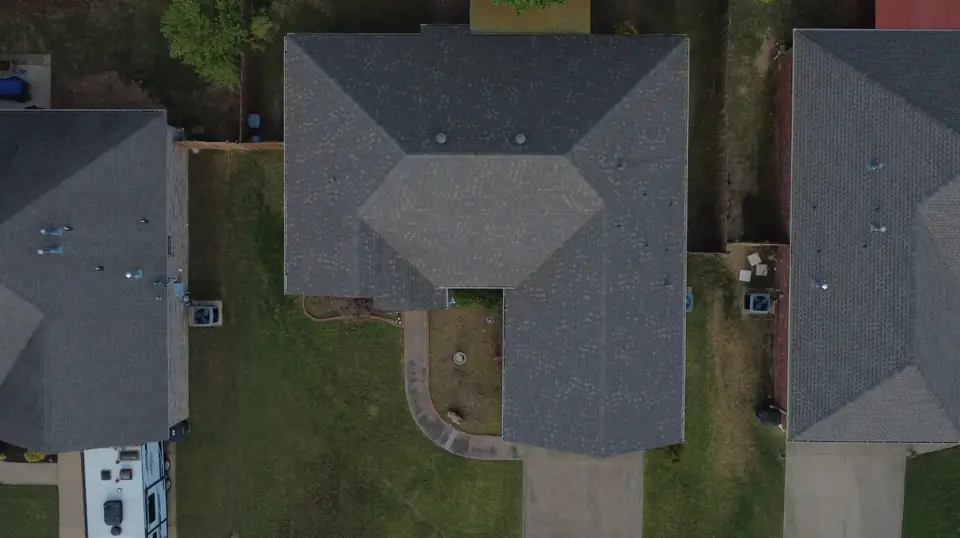
An open valley shows a strip of metal down the middle where two roof slopes meet. A closed valley covers that line with shingles, so you see no metal. Both are accepted ways to build a valley, and what matters most is that the one chosen is installed to the shingle maker's written instructions, with a waterproof membrane under it. This post explains how each type is built, what Atlas says about each, and what to ask a roofer before you sign.
What is the difference between an open and a closed valley?
A roof valley is the channel where two slopes meet and carry rain down to the gutter. There are two common ways to finish it.
- Open valley: a metal lining runs down the center and the shingles on each side are trimmed back from it. You can see the metal from the ground.
- Closed valley: shingles cover the valley line. In the closed cut method, the shingles from one slope run across the valley and onto the other slope, and the shingles from the second slope are trimmed to meet them. In a woven valley, shingles from both slopes are overlapped in alternating courses.
What does Atlas say about open valleys?
Atlas publishes shingle installation instructions on its own website. For its Pinnacle Pristine and StormMaster Shake lines (checked November 27, 2026), the open valley steps include:
- Apply a 36 inch ice and water product centered in the valley.
- Install metal lining (Atlas names copper at least 16 inches wide, or an equivalent) also centered in the valley.
- Snap chalk lines on each side of the valley 3 inches from the center line.
- Cut 2 inches diagonally off the upper corner of the shingles next to the chalk line.
- Set the valley edge of each shingle in a 3 inch wide band of asphalt plastic cement.
- Nail no closer than 6 inches from the valley center line.
The takeaway is that an open valley is a layered system: membrane first, metal over it, then shingles trimmed to a straight line. The metal and the cement are doing real work, so the quality of the lining matters.
What does Atlas say about closed valleys?
For the closed cut valley, the same Atlas page says to apply a 36 inch wide ice and water product centered in the valley, nailed 2 inches from the outer edges only. Shingles on one side then run across the center of the valley a minimum of 12 inches. Nails stay at least 6 inches from the center line on the unshingled side, a chalk line is struck 2 inches from the center line, and the underlying shingle is not cut. Atlas also publishes separate closed valley and California valley bulletins that use the same 6 inch nail rule and the same 12 inch extension.
The closed method hides the valley under shingles, which many homeowners like. The tradeoff is that the shingles in the valley see the full flow of water, so the underlayment beneath them has to do its job.
Which one is better?
Neither is better in every case. Open valleys move water and debris quickly because the metal is smooth. Closed valleys look more uniform. A shingle maker may allow one method for one product and set conditions on another, so the right answer depends on the shingle and the roof. We would not pick a valley type from a photo. Pick it from the manufacturer's instructions for the shingle going on your roof.
What both methods share is a membrane under the valley. Every Patriot roof package puts ice and water shield in the valleys, as listed in our package details. You can read more in our post on ice and water shield on an Arkansas roof.
What to ask your roofer
- Which valley method are you using on my roof, and does the shingle maker's instruction allow it?
- What goes under the valley before the shingles?
- If it is an open valley, what metal and what width?
- How far are nails kept from the valley center line?
- Will I get photos of the valleys before they are covered?
Valleys are covered up once the shingles go on, which is why photos during the job matter. A full roof replacement with Patriot Roofing and Restoration comes with the Patriot Leak Free Guarantee for your package term (Armor 15 years, Shield Plus 15 years, Shield 10 years, Economy 5 years).
Can a leaking valley be fixed without a new roof?
Often yes. We publish valley repair prices by length on our roof repair price book, and a repair visit is $79.99.
Frequently asked questions
Is an open valley or a closed valley more likely to leak?
Either can leak if it is built wrong. Most valley leaks trace back to nails too close to the center, shingles cut short, worn lining or debris, not to the method itself.
Can you see the metal in a closed valley?
No. Shingles cover the valley line, so you see only shingles from the ground.
Can I switch from a closed valley to an open valley later?
It means removing shingles along the valley and rebuilding it, so it is easiest at replacement time. A roofer can tell you what a change would involve once they see the roof.
Do I need to clear my valleys?
Keeping them clear helps water flow, but please stay off the roof. Large debris removal is one of the services offered through the Patriot Care Club.
Want your valleys checked?
Our inspection report comes with photos, so you can see what is going on. Book your roof inspection.
21-Point Roof Inspection
Your Roofing Specialist checks the roof and attic and gives you a 21-point report with photos of what we find.
Roof Repair Diagnostic Visit
Includes the 21-Point Roof Inspection Report and attic analysis. Patriot Care Club members pay a $19.95 diagnostic fee.