
Can Missing Shingles Cause a Roof Leak?
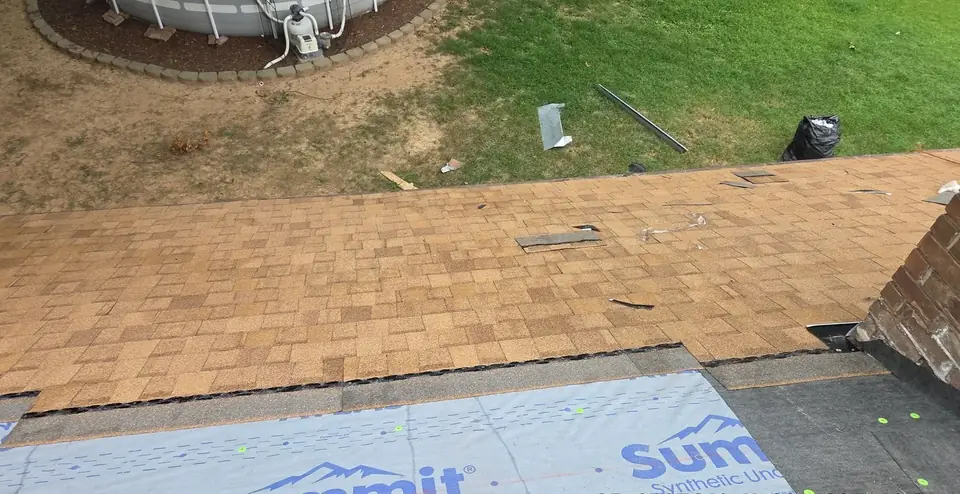
Yes, missing shingles can cause a roof leak, but usually not the same day they blow off. Under every shingle is a layer of underlayment, and a healthy one will often keep water out for a while. The trouble is that underlayment is not made to sit in the sun and rain on its own, and the open spot also exposes the nails and the shingles around it. So a missing shingle is a leak that has not happened yet. The sooner it is replaced, the less chance of wet decking, a stained ceiling or a bigger repair.
Below is what is actually under a missing shingle, how long you can reasonably wait, what to do today, and what a fix costs from our published price book.
What is under a missing shingle
A shingle roof is built in layers. From the top down:
- Shingles. They shed water and protect everything below them from sun and weather. Each one overlaps the course below it and is nailed through that overlap.
- Underlayment. A sheet of felt or synthetic material rolled over the whole roof deck. On a standard slope, Atlas's Pinnacle Impact instructions say a single layer of approved underlayment is required, and a double layer on low slopes.
- Roof decking. The plywood or OSB sheets nailed to the rafters or trusses. This is the part that rots and sags when water gets in over time.
When a shingle tears off, the layer you see from the ground is usually the shingle below it, the underlayment, or both. On a roof that is losing a whole section, you may see bare underlayment or even decking.
Why a missing shingle turns into a leak
Underlayment resists water, but it is a backup, not a roof. Atlas describes its Summit 60 synthetic underlayment as water resistant and rated for 60 days of UV exposure. That is enough time to get shingles on during a replacement. It is not meant to be the top layer for a season, and on an older roof the underlayment may be felt that is many years old.
A missing shingle also creates problems around it:
- Exposed nails. The nails that held the shingle above are now open to the weather. Water can follow a nail shank straight through the underlayment into the decking.
- Loose neighbors. Wind that removed one shingle has usually broken the seal on the shingles next to it. Atlas notes that the adhesive strips on each shingle seal to the shingle beneath with heat from sunlight. Once that bond breaks, the next gust has an edge to catch.
- Wind-driven rain. Hard rain blowing sideways can push water up under the exposed edge of the course above.
Where the shingle was matters, too. A missing shingle near a valley, a chimney, a wall or a vent pipe is more urgent than one in the middle of a slope, because water already concentrates in those spots.
How long can you wait?
We cannot give you a safe number of days, and you should be wary of anyone who does. It depends on the age of the underlayment, where the gap is, the slope, and the weather coming. What we can say from the roofs we repair:
- One shingle missing on a newer roof, mid-slope, with no rain in the forecast: book a repair soon, but this is not an emergency.
- Several shingles missing, bare underlayment or decking showing, or the gap is near a valley, wall or pipe: treat it as urgent, especially with storms in the forecast.
- Water is already coming in: call right away. Our phones are answered live 24/7 and we do emergency tarping.
Either way, check the attic under that spot after the next rain. A dark stain on the decking, damp insulation or a drip on the attic floor means water is already getting through.
What to do today
- Stay off the roof. A roof after a storm is slick, and loose shingles slide. Look from the ground, or use binoculars.
- Take photos. Shingles in the yard, the bare spot on the roof, and any ceiling stain, with the date. If the shingles came off in a windstorm, these help with an insurance claim.
- Keep the shingles you find. They help match the brand and color.
- Check inside. Look at ceilings below that area and in the attic if you can get there safely.
- Call a roofer. If water is coming in, ask for an emergency tarp first. See our guide to emergency roof repair for what to do in the first hour.
How missing shingles are fixed
On a repair, we lift the shingles above the gap, pull the damaged pieces and old nails, slide in new shingles, nail them where the manufacturer calls for, and seal them so they lie flat and blend with the roof. We also check the shingles around the spot, because wind rarely takes just one.
Two details make the difference between a repair that holds and one that blows off at the next storm:
- Sealing. New shingles seal to the ones below with heat from the sun. In cold weather that can take a while, so ARMA's cold-weather recommendations (revised March 2022) say shingles can be hand-sealed with an approved asphalt roofing cement for better protection from wind blow-off. The cement goes in small spots; Atlas warns that too much roofing cement can cause shingles to blister.
- The shingles above. Lifting the course above to nail the new shingle breaks that course's seal too. A good repair re-seals those as well.
About color: a new shingle can look brighter than shingles that have weathered for years, even when it is the same color from the same line. It usually blends in as it ages. If your roof's shingle is no longer made, we show you the closest match before we start. Atlas is our primary line, and we install just about any brand a customer needs to match an existing roof.
What it costs to replace missing shingles
We publish our repair prices. On a standard-pitch (up to 6/12), one-story home:
- Replace up to 5 shingles: $379
- Replace up to 1 bundle of shingles (about 33 square feet): $786
- Replace up to 2 bundles (about 66 square feet): $1,038
- Replace up to 3 bundles (about 100 square feet, roughly one roofing square): $1,316
Steeper roofs cost more, and two-story homes add 12%. Every line, including larger patches, is on our roof repair price book. A repair visit starts with a $79.99 diagnostic that includes our 21-point roof inspection and attic analysis; Patriot Care Club members pay no service fee and get 10% off repairs. You approve the price before any work begins.
Repair or replace?
A few missing shingles do not mean you need a new roof. If the roof is under 15 years old, was installed correctly and the damage is in one area, a repair usually makes sense. If shingles keep coming off in every storm, the roof has been patched before, or it is near the end of its life (in Arkansas we figure 15 to 20 years for asphalt shingles), replacement is often the better use of money. Our repair or replace guide walks through the decision, and we will tell you which one we would choose for our own home.
Missing shingles after a windstorm and insurance
Shingles torn off by wind are storm damage, and many homeowners policies treat sudden wind damage differently from wear and tear. Coverage depends on your policy, its deductible (some Arkansas policies carry a separate wind or hail deductible) and the age and condition of the roof. Our posts on wind vs hail roof damage and whether insurance covers roof replacement explain how insurers look at it. The deductible is always the homeowner's responsibility.
If your shingles came off in a storm, the inspection is free: we do not charge for hail, wind and storm damage inspections, and you get our 21-Point Roof Inspection Report with photos. If damage is found, we work with your insurance company and meet the adjuster. This is general information, not insurance advice; coverage and deadlines vary by policy and carrier, so confirm with your agent.
Frequently asked questions
Will one missing shingle cause a leak?
Not always right away, but it can. The underlayment beneath may hold for a while, but the exposed nails and loosened shingles around the gap are where water usually finds its way in. Replace it soon rather than waiting for a stain.
Can I put a tarp over missing shingles myself?
We do not recommend climbing a roof after a storm. A badly fastened tarp can also blow loose or trap water. If you need one, call us for emergency tarping.
Why do shingles blow off a fairly new roof?
Usually because the sealant strip never bonded well, the shingles were nailed in the wrong place, or the wind was simply stronger than the shingle is rated for. A repair should fix the cause, not just replace the shingle. Our post on what causes roof leaks covers the other usual suspects.
Is the repair guaranteed?
Yes. If a repair leaks within 365 days, we repair it again at no charge. Once all recommended repairs are done, your roof is covered by the 365-Day Patriot Leak Free Guarantee.
How fast can you come out?
Call 501.441.2900; our phones are answered live 24/7 for emergencies. Patriot Care Club members get a priority appointment within 24 hours.
Shingles in the yard?
Do not wait for the ceiling stain. Contact us to book a repair visit or a free storm inspection, and we will get your roof repair done right the first time.
21-Point Roof Inspection
Your Roofing Specialist checks the roof and attic and gives you a 21-point report with photos of what we find.
Roof Repair Diagnostic Visit
Includes the 21-Point Roof Inspection Report and attic analysis. Patriot Care Club members pay no service fee.