What Is a Class 4 Shingle? UL 2218 Impact Ratings Explained
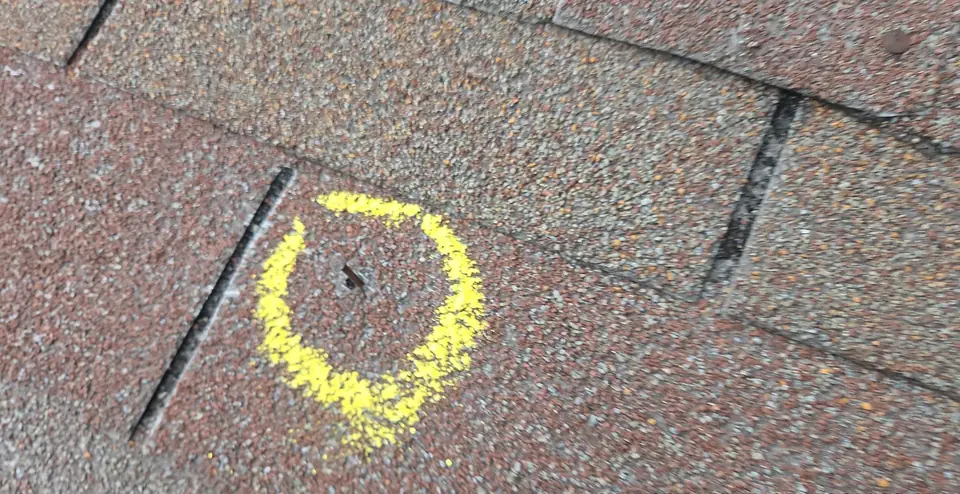
A Class 4 shingle is one that earned the top rating, Class 4, under UL 2218, the Underwriters Laboratories standard for impact resistance of roof coverings. In the test, a steel ball is dropped on the shingle, and Class 4 uses the biggest ball (2 inches across) from the greatest height (20 feet). If the shingle shows no break through to the back after those hits, it passes. Class 4 is the highest impact rating a shingle can carry under UL 2218, and it is the rating insurance agents usually ask about. It is not a promise that hail will never damage the roof, and it is not a hail warranty.
UL 2218 classes at a glance
| Class | Steel ball diameter | Drop height | Roughly the size of |
|---|---|---|---|
| Class 1 | 1-1/4 in | 12 ft | a little larger than a quarter |
| Class 2 | 1-1/2 in | 15 ft | a ping pong ball |
| Class 3 | 1-3/4 in | 17 ft | a golf ball |
| Class 4 | 2 in | 20 ft | a hen egg |
Ball sizes and drop heights as published by Crenshaw and Koontz, "Simulated Hail Damage and Impact Resistance Test Procedures," IIBEC Interface, May 2001. Size comparisons from the National Weather Service hail size guide (1.00 in quarter, 1.50 in ping pong ball, 1.75 in golf ball, 2.00 in hen egg). Checked November 2026.
How the UL 2218 test works
UL Solutions says it developed UL 2218, the Standard for Impact Resistance of Prepared Roof Covering Materials, in the 1990s, and that it has "four ratings, Class 1, 2, 3 and 4, based on replicating impact energies for natural hailstones by dropping steel balls from various heights." The heavier the ball and the higher the drop, the harder the hit, so each class is a step up in impact energy. The 2001 IIBEC paper puts the Class 4 hit at about 23 foot-pounds, from a 1.15 pound steel ball, against about 3.4 foot-pounds for Class 1.
What counts as a pass matters. UL says its requirements "are based on physical breach damage viewed from the back side of shingles, but do not account for denting or granule loss." In plain words, the lab turns the shingle over and looks for cracks or splits that go through it. A dent on the top, or granules knocked loose, does not fail the test. That is why a Class 4 roof can still show marks after a hailstorm.
The IIBEC paper also notes that UL testing is done on new roof coverings at room temperature. A shingle on a roof ages, bakes in the sun and gets cold in winter, and none of that is part of the test.
Steel balls are not hailstones
A steel ball hits the same way every time, which makes the test repeatable. Real hail does not. Hailstones vary in size, density and shape, they can be soft or hard, and they come down at angles in wind. The IIBEC authors wrote that ice spheres "are currently the closest simulation of hail," though no lab ice ball is an exact copy of a hailstone. So the class is best read as a comparison: a Class 4 shingle stood up to harder lab hits than a Class 3, and much harder than an unrated one.
Other impact tests you may see
FM 4473: ice balls
FM Approvals' standard 4473 fires freezer ice balls from a launcher instead of dropping steel. It uses the same four sizes as UL 2218 (1-1/4, 1-1/2, 1-3/4 and 2 inches for Classes 1 to 4), hits each target spot twice, checks the top and the bottom of the sample, and requires "no evidence of visible cracking or breakage." The July 2005 edition we read is written for rigid roofing such as slate, concrete or clay tile and planks, so you will see it more on those products than on asphalt shingles. Some manufacturers list both ratings on accessories such as hip and ridge caps.
IBHS hail ratings: dents and granules count
The Insurance Institute for Business and Home Safety (IBHS) built its own test because UL 2218 only looks for breaks. Its protocol (June 2019) fires lab-made hailstones, both soft and hard, at 1.5 and 2 inch sizes, onto new shingles and scores the top surface for dents, ridges, patches of lost granules and breaks. Products are rated Excellent, Good, Marginal or Poor. IBHS says impact-rated products on its scorecard are re-tested every 2 years and that the 2 inch results are public. Its summary found that every impact-rated shingle that rated Good or Excellent at 2 inches was made of polymer-modified asphalt, and that dents were consistently the weakest scores.
In 2023 UL and IBHS announced a joint program for shingle performance evaluation. Both paths in that program require the shingle to be certified to UL 2218 first, so Class 4 is the starting line for the IBHS ratings, not a replacement for them.
What Class 4 does not mean
- It is not hail-proof. Large or dense hail can still crack, dent or bruise a Class 4 shingle, and granule loss is not part of the UL pass test.
- It is not a hail warranty. Manufacturers' shingle warranties generally exclude hail. Atlas, for example, lists hail among the acts of God excluded in its Signature Select residential shingle warranty. Hail damage is a matter for your homeowners insurance.
- It is not a wind rating. Wind resistance is tested separately under ASTM D3161 and D7158. See our post on shingle wind ratings.
- It is not a FORTIFIED roof. FORTIFIED is an IBHS program covering how the whole roof is built and documented. A Class 4 shingle can be part of one, but the shingle alone is not the designation.
- It does not guarantee an insurance discount. A Class 4 roof may qualify for a discount with some insurers, and it varies by insurer and policy. Ask your agent before you choose.
How to tell if a shingle is really Class 4
The rating belongs to a specific product, so check it on the manufacturer's own product page or data sheet, not on a sales flyer. Look for "UL 2218 Class 4" by name. Some product lines are Class 4 only on certain packages, so the wrapper statement matters. Insurers that give credits often go by the label: State Farm's roofing product listing, for example, says only products with the proper certification label are eligible. Keep a wrapper or the label photo, the product name and your invoice with your house papers. Some insurers also ask whether the hip and ridge caps and other roof parts are impact rated, so ask your agent what they need to see.
Class 4 on Patriot roofs
Atlas, our primary shingle line, makes two Class 4 lines under UL 2218: StormMaster Shake and Pinnacle Impact. Its Pinnacle Pristine and Pinnacle Sun lines are Class 3. Here is how impact rating fits our roof replacement packages:
| Package | Roof covering | Hail rating | Patriot Leak Free Guarantee |
|---|---|---|---|
| Armor | 26-gauge PBR steel panel (metal roof) | Rated for hail up to 2 inches | 15 years |
| Shield Plus | Class 4 impact-rated shingle (UL 2218), with impact-rated hip and ridge | Rated for hail up to 2 inches | 15 years |
| Shield | Class 3 impact-rated architectural shingle, with impact-rated hip and ridge | Rated for hail up to 1-3/4 inches | 10 years |
| Economy | Standard architectural shingle | Not impact rated | 5 years |
Shield Plus is our Class 4 shingle roof and carries a 15-year Patriot Leak Free Guarantee. Our guarantee covers leaks and workmanship and, like the manufacturer's warranty, excludes acts of God; storm damage is handled through your homeowners insurance, and we work with your insurer on the claim. Full details are on our roof replacement page and the guarantees page. For more on how impact-rated shingles fit Arkansas hail, read our guide to impact-resistant shingles and how Class 4 shingles and insurance discounts work in Arkansas.
Frequently asked questions
What is a Class 4 shingle?
A shingle that passed the UL 2218 impact test at its top level: a 2 inch steel ball dropped from 20 feet without breaking through the shingle. It is the highest impact rating under that standard.
What is the difference between Class 3 and Class 4 shingles?
The size of the ball and the drop. Class 3 is a 1-3/4 inch ball from 17 feet; Class 4 is a 2 inch ball from 20 feet, a noticeably harder hit. Both are impact rated; Class 4 is the top rating.
Can a Class 4 roof still get hail damage?
Yes. The test only checks for breaks through the shingle with steel balls on new shingles. Real hail, an aged roof, dents and granule loss are outside the test, and large hail can damage any roof.
Is FM 4473 the same as UL 2218 Class 4?
They use the same ball sizes for each class, but FM 4473 fires ice balls and checks both sides of the sample, and it is written for rigid roofing such as tile and slate. UL 2218 drops steel balls and is the rating you will usually see on asphalt shingles.
Do Class 4 shingles lower insurance in Arkansas?
They may, depending on your insurer and policy. Call your agent before you choose a shingle and again after the roof is installed. Our Class 4 insurance discount post walks through both calls.
Get a straight answer for your roof
Wondering whether a Class 4 roof is worth it on your home, or whether your current roof made it through the last hailstorm? Contact us or call 501.441.2900. Storm and replacement inspections are free, and we will show you every option in writing.
21-Point Roof Inspection
Your Roofing Specialist checks the roof and attic and gives you a 21-point report with photos of what we find.
Roof Repair Diagnostic Visit
Includes the 21-Point Roof Inspection Report and attic analysis. Patriot Care Club members pay no service fee.