
Standing Seam vs Exposed Fastener (PBR) Metal Roofs
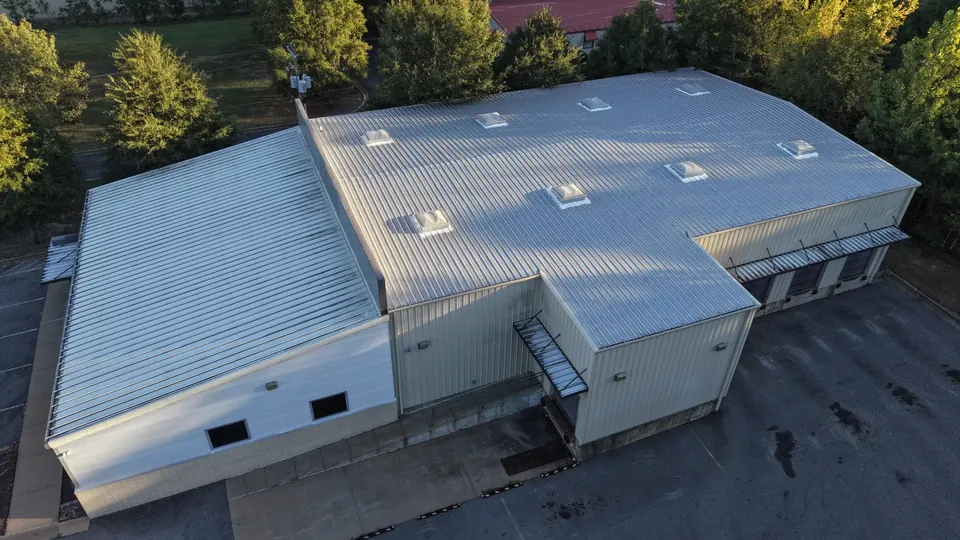
The difference between standing seam and exposed-fastener metal roofing (PBR or R-panel) is how the panels are held down. Exposed-fastener panels are screwed straight through the face of the metal, with a sealing washer under every screw head. Standing seam panels are held by clips or a fastening flange hidden under raised seams, so no screws show. That one difference drives everything else: exposed-fastener panels cost less and go on faster, while standing seam costs more, looks cleaner, handles lower slopes and needs less fastener upkeep. For most Central Arkansas homes with an ordinary pitch, an exposed-fastener steel panel is the value choice and standing seam is the premium one. Patriot Roofing and Restoration installs both.
Side by side
| Exposed fastener (PBR, R-panel) | Standing seam | |
|---|---|---|
| How it attaches | Screws through the panel face into the deck or purlins, each with a sealing washer | Hidden clips or a pre-punched flange under the seam |
| What you see | Ribs with rows of color-matched screw heads | Smooth flat pans between raised seams, no visible screws |
| Panel coverage | Typically about 36 inches wide | Narrower, often 18 inches or less |
| Roof slope | Not below 1:12; sealant tape at the laps below 3:12 | The usual choice below 1:12 |
| Heat movement | Panel moves against fixed screws | Clips or flange let the panel move |
| Upkeep | Screws and washers should be checked over the life of the roof | Minimal |
| Cost | Lower | Higher to buy and install |
| At Patriot | Our Armor package: 26-gauge PBR steel | Installed and priced in writing after we measure |
How exposed-fastener panels work
PBR and R-panel are ribbed steel panels that lap over one another along the edges. McElroy Metal, a metal panel manufacturer, says the panels "are attached to the roof deck or purlins with screws driven through the panels and into the substructure," and that each screw carries a metal cap and washer that "together provide a secure, weather-tight seal." Metal Sales, another manufacturer, says exposed-fastener panels are "typically" 36 inches wide and that the screw heads can be ordered in colors to match the panels. The PBR profile adds a bearing leg at the edge of each panel to support the lap with the next one.
Wide panels are why this system costs less. McElroy says exposed-fastener panels often cover about twice the width of a standing seam panel, which cuts labor, and that this type of roofing "is less expensive than standing seam roofing." Metal Sales puts it more bluntly: "Cost is the primary benefit of exposed fastener panels."
The trade-off: screws in the weather
Every screw is a hole through the roof, sealed by its washer. McElroy says leak issues "may not present themselves for 10-20 years until the washer around the fastener starts to degrade," and that exposed-fastener roofs "tend to require more maintenance to check and replace fasteners over the life of the roof." The fix is simple: McElroy says replacing worn screws with oversized fasteners is "a relatively easy and inexpensive process." MBCI, a metal building products maker, recommends checking the fasteners on a PBR roof every year.
Heat is the other factor. Steel grows in summer sun and shrinks on cold nights, and a screwed-down panel moves against fasteners that do not move. McElroy says that over time "the hole around the screw can enlarge" from that expansion and contraction, but that it is rare on panels shorter than 30 feet and more likely on long runs. Most house roofs have short panel runs from eave to ridge, which is one reason exposed-fastener panels work well on homes.
How standing seam works
Standing seam panels run from eave to ridge and lock together along tall seams. McElroy says they attach "with clips or a pre-punched fastening flange that allows for thermal movement," and Metal Sales says the system is "designed to conceal the fastener below the surface of the panel." There are two main seam styles. MBCI explains that snap-lock panels snap together over clips, while mechanically seamed panels "must be crimped together with a machine or by hand." McElroy says mechanical seams "routinely outperform snap seam systems" for structural and weathertightness performance, and they are the type used on the flattest roofs.
Because the fasteners are covered, standing seam needs little upkeep. McElroy says standing seam systems "require minimal maintenance," and MBCI calls them "virtually maintenance free," with an occasional hose-down or debris removal. The cost is the catch. McElroy says standing seam products "cost more to purchase and install than exposed fastened panels," partly because narrower panels mean more panels and more seams on the same roof; it notes many manufacturers cap standing seam panels at 18 inches wide.
Roof slope decides some jobs for you
On low-slope roofs the choice is not open. McElroy says "exposed fastener panels aren't appropriate for slopes below 1:12," and that between 1:12 and 3:12 a row of sealant tape is recommended at each panel lap to stop water wicking into the seam. At 3:12 and steeper, most exposed-fastener profiles can skip the tape. Below 1:12, McElroy says standing seam is "your best bet," and some mechanically seamed systems are made for slopes as low as 1/4:12.
For reference, our roof cost calculator treats 4/12 to 6/12 as a normal walkable pitch and 2/12 to under 4/12 as low slope. A typical house roof in the walkable range sits well above the 3:12 line where exposed-fastener panels do their best work. Porch roofs, additions and shed roofs are where a low pitch can push the job toward standing seam, and we check the pitch of every section when we measure.
What we install
Armor (exposed-fastener PBR). Our Armor metal roof is a 26-gauge PBR steel panel system, Class A fire rated and rated for hail up to 2 inches. It goes over synthetic underlayment with ice and water shield at the valleys and penetrations, an eave and trim starter system, color-matched metal drip edge, a metal ridge system, metal-rated pipe flashings and balanced, metal-compatible ventilation. Armor carries a 15-year Patriot Leak Free Guarantee and a 15-year No-Blame-Game Guarantee, the Leak Free Guarantee transfers to a new owner for its remaining term, and Armor includes the $250,000 Directorii Guarantee. In our calculator example, a 2,000 sq ft one-story walkable home is about $33,500 in Armor; try your own numbers in the roof cost calculator.
Standing seam. We install standing seam metal roofs too. Standing seam is priced in writing after we measure your roof, and its guarantee terms are spelled out in your written proposal, so you can compare it with Armor on the same visit.
Either way, we tear off to the decking, check it, and replace the first 2 sheets of bad decking at no charge before the new roof goes on. A metal roof typically lasts 40 to 70 years, against 15 to 20 years for asphalt shingles in Arkansas. For the full menu of metal styles and materials, see our guide to the types of metal roofing, and for budgets, what a metal roof costs in Arkansas.
Which one fits your home?
- Choose exposed fastener (like Armor) if your roof has a normal pitch, you want the longest-lasting roof for the money, and you do not mind seeing a neat pattern of color-matched screws.
- Choose standing seam if you want no visible fasteners and a sleek, modern look, part of your roof is very low slope, or you would rather pay more up front than check screws later.
- Either way, compare gauge, panel profile, underlayment, trim and the written guarantee on every quote, not just the price. A thinner panel or skipped underlayment can make one bid look cheaper.
If you go with exposed fastener, a yearly look at the screws is cheap insurance. Our Patriot Care Club includes an annual 21-Point Roof Checkup with photos for $14.95 a month.
Frequently asked questions
Is PBR the same as exposed fastener?
PBR is one kind of exposed-fastener panel. It is an R-panel style profile with an extra bearing leg at the lap. R-panel and PBR are both screwed through the face.
Do exposed-fastener metal roofs leak?
Not when they are installed right and the fasteners are looked after. The weak point is the washer under each screw, which McElroy says can start to degrade after 10 to 20 years. Swapping worn screws for oversized ones is an easy repair.
Is standing seam worth the extra cost?
It depends on what you value. Standing seam buys a cleaner look, hidden fasteners, less upkeep and the ability to go on very low slopes. If none of those matter much to you, an exposed-fastener panel gives you a metal roof for less.
Which is better for hail?
Hail ratings belong to a specific panel and gauge, so compare the rating of each panel you are quoted. Armor is rated for hail up to 2 inches. For standing seam, ask for the rating of the exact panel in your proposal.
Do you repair both kinds of metal roof?
Yes. Metal roof repairs start with our $79.99 diagnostic visit, free for Patriot Care Club members, and once all recommended repairs are done they carry our 365-Day Patriot Leak Free Guarantee.
Compare them on your own roof
Book a free replacement inspection. A Roofing Specialist will measure your roof, check the pitch of every section, and give you written prices for Armor and standing seam so you can see the difference in dollars, not just in theory.
21-Point Roof Inspection
Your Roofing Specialist checks the roof and attic and gives you a 21-point report with photos of what we find.
Roof Repair Diagnostic Visit
Includes the 21-Point Roof Inspection Report and attic analysis. Patriot Care Club members pay no service fee.