

Why a Consultative Roofer Who Explains Options Is Worth More in the Long Run
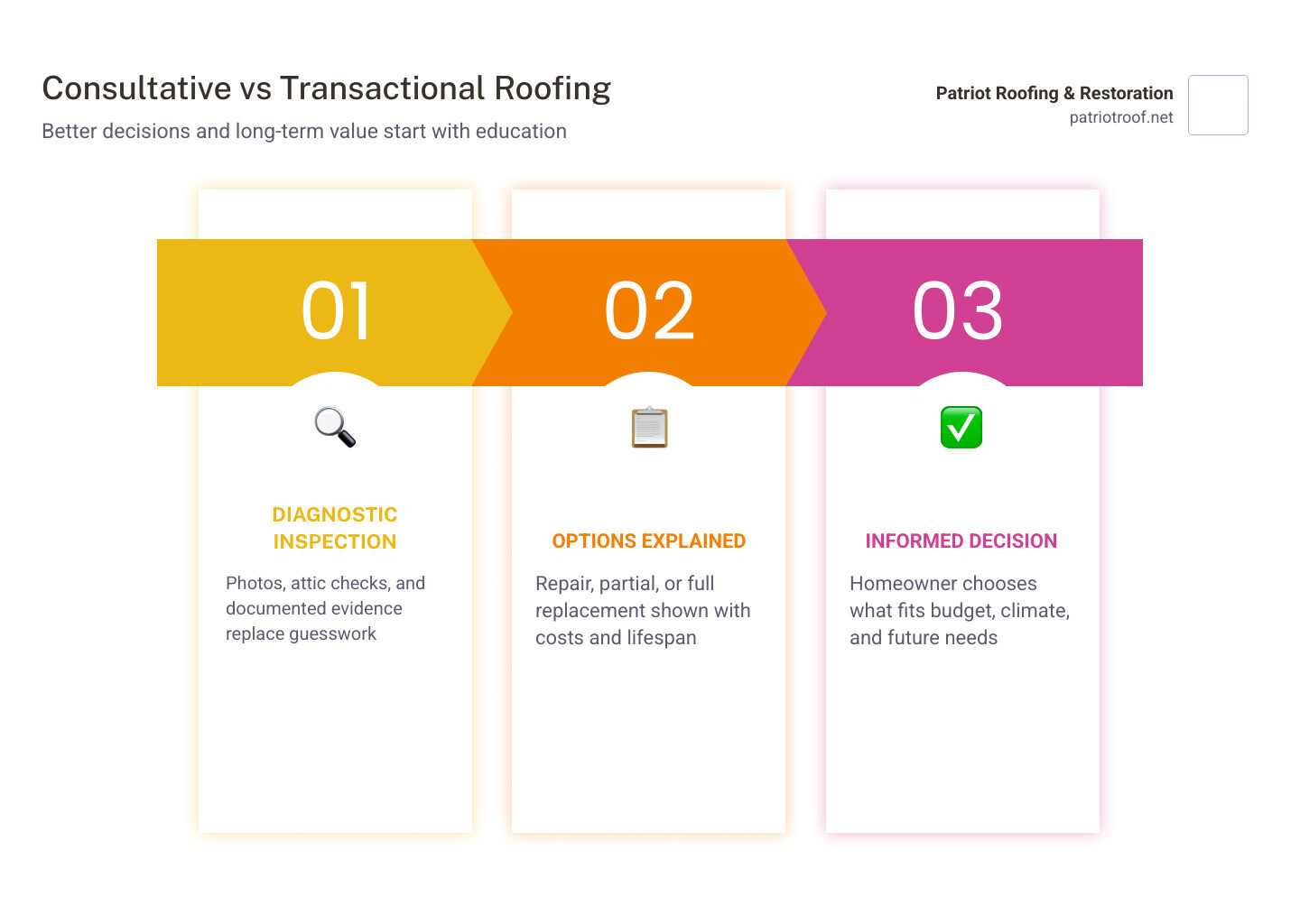
Understanding why a consultative roofer who explains options is worth more in the long run comes down to one simple truth: when a roofer takes the time to diagnose your roof, explain what they found, and lay out real choices — you make better decisions, avoid costly surprises, and get a roof that actually fits your home, your budget, and your life.
Here’s the short answer if you’re in a hurry:
A consultative roofer is worth more because they:
- Diagnose your roof’s actual condition instead of just dropping a price
- Show you documented evidence — photos, inspection notes, attic checks
- Present multiple options (repair, partial replacement, full replacement) so you choose what’s right for you
- Help you understand long-term costs, not just today’s invoice
- Stay legally compliant when insurance claims are involved
- Follow through from sale to finished job — no broken promises
The alternative — a fast, price-first quote with no explanation — is exactly how one in three homeowners end up with problems after roofing work, according to a poll by Angie’s List. Of those who had issues, 68% pointed to shoddy workmanship as the root cause.
That’s not a pricing problem. That’s a process problem.
A roof is your home’s first line of defense against rain, wind, and extreme temperatures. In a place like Little Rock, where storms can be severe and humidity accelerates wear, the roofer you choose — and how they communicate — matters far more than who gave you the lowest number on a piece of paper.
Must-know why a consultative roofer who explains options is worth more in the long run terms:
- choosing a roofing contractor in central arkansas
- how to spot storm-chasing roofers after a severe weather event in arkansas
- how to verify a roofing contractor is licensed and insured in arkansas
Transactional vs. Consultative: Why a Consultative Roofer Who Explains Options Is Worth More in the Long Run
When it is time to address a roofing issue, homeowners in Central Arkansas generally encounter two distinct types of contractors: transactional sellers and consultative advisors. The difference between these two approaches shapes your entire experience, your financial investment, and the ultimate protection of your home.
A transactional roofing sale is built on speed and volume. The contractor’s goal is to collect your address, quickly walk or scan your roof, drop a single price, and push for a signature. This “quote-and-ghost” strategy commoditizes your home’s primary protective system. It assumes that every roof is identical and that every homeowner has the exact same goals, timeline, and financial situation.
Conversely, a consultative roofing sale is an educational partnership. We focus on diagnosing the physical asset, understanding your specific circumstances, and presenting tailored solutions. Instead of treating your project as a quick transaction, we act as advisors. This distinction is critical because a roof is not an off-the-shelf product; it is a complex, custom-engineered system that must be matched to your home’s architecture and your family’s plans.
By taking the time to explain your options, a consultative contractor helps you maximize your long-term return on investment. The data supports this: shifting from price-focused pitches to collaborative problem-solving can increase average contract values by $2,145 per job. This value is not driven by artificial markups, but by helping homeowners choose more durable, energy-efficient materials that prevent future repairs and lower utility bills. When you work with an advisor, you are investing in clarity, custom solutions, and long-term security.
The Transactional Trap of Price-First Quoting
The transactional approach relies heavily on the allure of the “lowest price.” While a cheap bid is tempting, it often masks a cycle of cut corners, hidden costs, and premature system failures.
When a contractor wins a project solely by offering the lowest price, they must find ways to protect their profit margins. This usually occurs in areas homeowners cannot easily see:
- Using low-grade, generic underlayment instead of high-performance synthetic barriers.
- Reusing old, rusted flashing instead of replacing it.
- Skipping critical ventilation calculations, which can trap heat in your attic and cook your shingles from the inside out.
- Employing untrained, transient crews who rush through the installation.
According to a historic Angie’s List poll, one in three homeowners who had roofing work done experienced problems with their contractor or developed issues down the line. Of those who gave detailed responses, 68% cited shoddy workmanship as the primary issue.
Furthermore, contractors who operate on razor-thin margins often lack the financial stability to honor their workmanship warranties. If a leak develops three years down the road, you may find their phone number disconnected, leaving you to pay out of pocket for repairs. Choosing a contractor based on a consultative, value-first approach helps you avoid these costly pitfalls. For a deeper look at balancing immediate costs with long-term system health, read The Definitive Guide to Roof Repair vs. Replacement.
The Psychology of the Expert Prescription
Purchasing a new roof is rarely a purely rational financial transaction; it is heavily driven by emotion. Homeowners often feel a mix of anxiety, confusion, and fear — fear of leaks damaging their interior, fear of making an incorrect financial decision, and fear of being taken advantage of by high-pressure sales tactics.
A consultative roofer addresses these anxieties by adopting the role of a trusted advisor rather than a salesperson. Think of this as the “expert prescription” model, similar to a visit to a medical specialist:
- The Doctor Analogy: A reputable doctor does not walk into an exam room, hand you a random prescription, and walk out. They ask about your symptoms, perform diagnostic tests, review the evidence with you, and explain the treatment options along with their pros and cons.
- The Consultative Roofer: We apply this exact methodology to your home. We do not pitch a specific shingle brand within the first five minutes. Instead, we perform a comprehensive diagnostic inspection, document our findings, and explain how different solutions address your specific concerns.
By providing clear visual evidence and explaining the “why” behind our recommendations, we build genuine trust. This transparency helps you make an informed decision with confidence, replacing stress with peace of mind.
The Consultative Discovery and Inspection Process
The consultative journey begins long before anyone steps onto your roof. It starts with a comprehensive discovery process designed to understand your unique needs and the specific history of your home.
Why a Consultative Roofer Who Explains Options Is Worth More in the Long Run During Intake
A transactional contractor’s intake process usually consists of two questions: “What is your address?” and “When can I drop off the quote?”
A consultative intake is a real conversation. We listen 70% of the time and speak only 30% of the time. We ask targeted questions to uncover your actual goals, the urgency of the project, and your long-term plans for the property. This ensures we do not recommend a temporary, short-term repair for a home you plan to live in for the next thirty years — or, conversely, a premium, century-grade system for a property you intend to sell next year.
During our intake process, we focus on several critical discovery questions:
- How long do you plan to own this home? (This shapes whether we recommend a standard repair, an economical replacement, or a premium, highly durable system that adds maximum resale value.)
- Have you noticed any recent changes in your energy bills? (This helps us identify potential attic ventilation or insulation issues that a simple shingle replacement won’t solve.)
- Have you experienced any moisture issues, peeling paint, or mold inside the home? (This points us toward specific areas of the roof deck or flashing that require close inspection.)
- What is your primary goal for this project — immediate leak prevention, storm restoration, aesthetic upgrades, or long-term durability? (This ensures our proposal aligns with your priorities.)
Separating Observed Facts from Recommendations
One of the most important aspects of building trust is strictly separating observed facts from professional recommendations. A consultative inspection report should read like an objective diagnostic report, not a sales pitch.
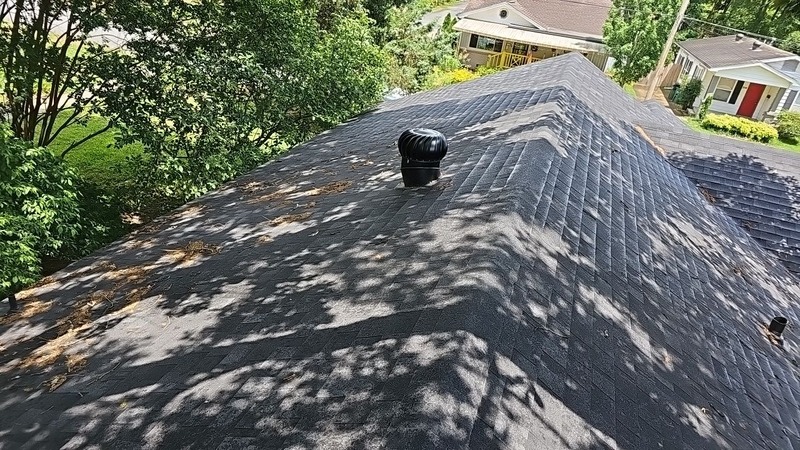
When we inspect your roof, we document its condition using objective metrics and a standardized photo set, capturing:
- Up-close photos of shingle wear, granule loss, and thermal cracking.
- Detailed views of penetrations, pipe boots, valleys, and flashing.
- Documentation of attic space, checking for roof deck sagging, water staining, and proper ventilation baffles.
We present these photos to you as raw, undeniable facts. Once we have established the current physical state of your roof, we transition to our recommendations. We explain why we recommend a specific course of action, linking each recommendation back to the photographic evidence. This clear separation ensures you never feel like we are manufacturing problems to close a sale.
Presenting Options and Navigating the Proposal
A consultative proposal is designed to give you control over the decision-making process. Rather than presenting a single, take-it-or-leave-it price, we offer clear, multi-tiered options that reflect different levels of investment and performance.
Why a Consultative Roofer Who Explains Options Is Worth More in the Long Run for Budgeting
Offering multiple options shifts your decision from a binary “yes or no” to a thoughtful “which option is best for my home and budget?” This approach has been shown to increase close rates by 20% to 40% because it respects your financial preferences and eliminates the pressure of a single, high-stakes number.
To help you visualize these choices, we structure our proposals using a clear Good/Better/Best framework:
| Feature/Specification | Good Option (Standard Repair / Economical) | Better Option (Architectural System) | Best Option (Premium / Impact-Resistant) |
|---|---|---|---|
| Primary Focus | Immediate protection, budget-conscious | Enhanced durability, standard warranty | Maximum wind/hail protection, premium warranty |
| Material Type | Standard 3-Tab Shingles | Laminated Architectural Shingles | Class 4 Impact-Resistant Shingles |
| Wind Resistance | Up to 110 mph | Up to 130 mph | Up to 130 mph+ with enhanced fastening |
| Algae Resistance | Standard protection | Enhanced Scotchgard / Algae-resistant | Premium lifetime algae protection |
| Workmanship Warranty | 5-Year Standard | 10-Year Extended | Lifetime / Patriot Shield Guarantee |
| Best Suited For | Short-term ownership, minor targeted repairs | Most family homes in Central Arkansas | Homes in high-wind/hail areas, long-term owners |
By presenting these options clearly, we help you weigh the upfront cost against the long-term total cost of ownership. We also provide access to flexible financing solutions, helping you choose the right level of protection without compromising on quality. To learn more about these options, see A Practical Guide to Roofing Financing for Arkansas Homeowners.
The Legal and Ethical Boundaries of Insurance Claims
Navigating an insurance claim after a storm can be incredibly stressful, and it is an area where transactional roofers often cross dangerous legal and ethical lines.
It is vital to understand the strict legal boundaries governing roofing contractors and insurance claims:
- No Public Adjusting: Unless a roofing contractor is also licensed as a public insurance adjuster, they cannot legally negotiate, settle, or manage your insurance claim. A consultative roofer will provide you with factual, photographic evidence and a detailed, line-item estimate that you can submit to your adjuster. We do not “negotiate” your claim; we provide the objective facts to support your loss.
- The Deductible Law: In many states, including Arkansas, it is illegal for a contractor to waive, rebate, or absorb a homeowner’s insurance deductible. Any contractor who offers to “write off” your deductible or hide it in the invoice is asking you to participate in insurance fraud.
A consultative contractor will always operate with complete transparency, protecting you from legal liability and ensuring your claim is processed ethically. For guidance on verifying your contractor’s credentials, check out How to Verify a Roofing Contractor is Licensed and Insured in Arkansas.
Climate Realities, Material Lifespans, and Long-Term Performance
Central Arkansas has a unique climate that places severe stress on residential roofing systems. From intense summer heat and high humidity to sudden hailstorms and heavy rainfall, your roof must be engineered to withstand diverse environmental pressures.
Matching Materials to Regional Weather Patterns
A consultative roofer does not recommend the same shingle to every homeowner. We analyze how regional climate patterns affect different materials and tailor our recommendations accordingly:
- Asphalt Shingle Lifespans: While standard 3-tab shingles may last 15 to 20 years in milder climates, our intense summer heat can shorten that lifespan. High-quality laminated architectural shingles, such as Atlas Pinnacle or Pristine, offer significantly better thermal stability and wind resistance, typically lasting 25 to 30 years with proper attic ventilation.
- Impact Resistance: In storm-prone areas like Cabot, Conway, and Benton, upgrading to Class 4 impact-resistant shingles can protect your home from devastating hail damage and often qualifies you for substantial discounts on your homeowner’s insurance premiums.
- Water Management and Gutters: Arkansas’s high rainfall volume can quickly overwhelm standard water management systems. We evaluate your gutter system alongside your roof to ensure water is shed safely away from your foundation, protecting your home’s structural integrity.
To explore these material choices and regional considerations in detail, explore our guides:
- The Ultimate Guide to Best Asphalt Shingles for Central Arkansas Homes
- A Practical Guide to Asphalt Shingle Options: Atlas Pinnacle vs. Pristine
- Guide to Impact Resistant Shingles
- Benefits of Impact Resistant Shingles
- Everything You Need to Know About How Arkansas Rainfall and Storm Volume Accelerates Gutter Wear
- The Definitive Guide to New Gutters Increasing Home Value
Protecting the Investment with a Seamless Production Handoff
The best consultative sales process is meaningless if the promises made during the consultation are lost on the way to the job site. A key indicator of a consultative contractor is a highly structured, documented handoff from the sales team to the production crew.
Before any materials are ordered or work begins, we compile a detailed “Sold-Job Handoff Package.” This document contains:
- The exact scope of work, including material brands, colors, and specific flashing details.
- High-resolution photos of the property, highlighting areas that require special protection (such as delicate landscaping, pools, or decks).
- Specific homeowner requests, such as preferred crew parking areas, pet safety instructions, and clean-up expectations.
This thorough communication ensures our production crew arrives on-site with a complete understanding of the project, preventing mid-job surprises and protecting the profit margins we need to remain in business and honor your warranties.
The Business Case: Metrics, ROI, and Team Coaching
Transitioning from a transactional, price-first model to a consultative, value-first model is not just a customer service choice; it is a highly effective business strategy that benefits both our team and our clients.
Quantifying the Financial Impact of Consultative Selling
When roofing teams adopt a consultative approach, the financial metrics improve across the board:
- Close Rates: Shifting from transactional pitching to collaborative problem-solving increases close rates by an average of 12.8%.
- Average Ticket Value: By helping homeowners understand the value of premium materials and complete system upgrades, the average ticket value typically rises from $11,500 to $14,200. This results in $142,000 in revenue versus $92,000 from the exact same lead volume.
- Profit Margins: Presenting multi-option proposals yields an average 34.2% increase in gross profit margins compared to price-only bidding.
- Customer Referrals: Satisfied clients who feel respected and educated generate 2.4 times more referrals than those who experience a transactional sale.
The Weekly Coaching Loop and Process Consistency
To maintain these high standards, we implement a weekly coaching loop focused on real job records and process compliance.
During these sessions, we review:
- Discovery notes and photo sets to ensure our inspections remain thorough, objective, and safe.
- Proposal designs to verify that we are offering clear, helpful options tailored to each homeowner’s needs.
- Client feedback to continually refine our communication style.
This continuous training ensures every member of our team consistently delivers the same clear, educational, and high-value experience to every homeowner we serve across Central Arkansas.
Frequently Asked Questions about Consultative Roofing
What is the difference between a consultative and transactional roofing sale?
A transactional sale is focused entirely on speed, volume, and low price. The contractor quickly drops a single bid and pushes for a signature, often leading to cut corners and poor communication. A consultative sale is an educational partnership. We perform a deep, diagnostic inspection, document our findings with photos, present multiple options, and help you choose the solution that best fits your long-term goals and budget.
Is it legal for a roofer to waive my insurance deductible in Arkansas?
No. In Arkansas and many other states, it is illegal for a roofing contractor to waive, rebate, or absorb a homeowner’s insurance deductible. Any contractor who offers to do this is committing insurance fraud, which can carry severe legal penalties for both the contractor and the homeowner. A reputable, consultative contractor will always bill honestly and help you navigate your claim legally and ethically.
How do multi-option proposals help me save money long-term?
Multi-option proposals allow you to compare the upfront cost of a project against its long-term total cost of ownership. For example, upgrading to a premium, wind-resistant, or impact-resistant shingle may cost slightly more today, but it can save you thousands of dollars over the next twenty years by preventing storm damage, lowering your energy bills, and qualifying you for insurance discounts.
Conclusion
Choosing a roofing contractor is one of the most important decisions you will make for your home. While a cheap, transactional bid might seem attractive on paper, it often leads to a cycle of shoddy work, hidden costs, and stressful communication.
At Patriot Roofing & Restoration, we believe you deserve a better experience. Our quality-first approach is backed by industry-leading warranties, the Patriot Shield Leak-Free Guarantee, and our elite Atlas certification. We take the time to inspect your roof thoroughly, explain your options clearly, and help you make a decision you can feel confident in for decades to come.
We proudly serve homeowners throughout Central Arkansas, including Alexander, Austin, Benton, Bryant, Cabot, Conway, Hot Springs, Hot Springs Village, Jacksonville, Little Rock, Maumelle, Mayflower, North Little Rock, Scott, Sherwood, and West Little Rock.
Ready to experience the value of a true consultative partnership? Schedule a consultative roofing assessment with Patriot Roofing & Restoration today, and let us help you protect what matters most.