
Do You Need a Permit to Replace a Roof in Little Rock or Maumelle, Arkansas?
If you’re wondering do you need a permit to replace a roof in little rock or maumelle arkansas, here’s the short answer:
Yes — in most cases, a roofing permit is required for a full roof replacement in both Little Rock and Maumelle.
| City / Jurisdiction | Permit Required for Full Replacement? | Minor Repairs Exempt? |
|---|---|---|
| Little Rock (Pulaski County) | Yes | Yes (small repairs) |
| Maumelle | Yes | Yes (small repairs) |
Replacing your roof is one of the biggest investments you’ll make as a homeowner. But before the first shingle comes off, there’s an important step most people overlook: making sure the right permits are in place.
In Central Arkansas, skipping this step can mean fines, stop-work orders, or serious headaches when it’s time to sell your home. And with Pulaski County issuing over 3,200 roofing permits in a single year, this is clearly not a formality that local authorities take lightly.
This guide walks you through exactly what’s required in both Little Rock and Maumelle — so you can move forward with confidence and avoid costly mistakes.
Both Little Rock and Maumelle enforce local building codes modified from the International Residential Code (IRC). These guidelines exist to protect your family’s safety, preserve the structural integrity of your home, and ensure that any work performed by a contractor meets rigorous safety standards.
When planning a Roof Replacement Little Rock, understanding these rules is the first step toward a seamless, stress-free home improvement project.
When Do You Need a Permit to Replace a Roof in Little Rock or Maumelle Arkansas?
Generally, any roofing project that goes beyond basic maintenance requires a building permit. Here are the specific scenarios where a permit is absolutely mandatory in both cities:
- Complete Tear-Off and Replacement: If you are stripping your roof down to the wooden decking and installing a brand-new weather-resistant barrier and shingles, you need a permit.
- Structural Changes: If your project involves changing the pitch of your roof, adding dormers, modifying structural trusses, or installing new skylights, this alters the load-bearing framework of your home and requires formal structural review.
- Deck Repair and Replacement: If a leak has rotted your roof deck (the plywood or OSB sheets under your shingles), replacing more than a minor section of this wood requires a permit to ensure the structural deck meets local load capacities.
- Re-Roofing (Overlaying): The IRC limits asphalt shingle roofs to a maximum of two total layers. If you are adding a second layer over an existing one, a permit is required to verify that the structure can handle the additional weight.
These rules are especially critical when dealing with Storm Damage Repair Little Rock, where underlying structural damage is frequently uncovered during the tear-off phase.
Exemptions: When Do You Not Need a Permit to Replace a Roof in Little Rock or Maumelle Arkansas?
Thankfully, you do not need to deal with city hall for every minor maintenance task. Both jurisdictions allow homeowners to complete minor, non-structural repairs without pulling a permit. Exemptions typically include:
- Replacing a Few Damaged Shingles: If a high wind blows off a handful of shingles, patching those specific spots does not require a permit.
- Minor Leak Patching: Sealing a small leak around a chimney or vent pipe using roofing cement or flashing updates is generally exempt.
- Small Outbuildings: In some cases, minor repairs on small, detached tool sheds or playhouses under a certain square footage do not require permits, though zoning setbacks still apply.
If you are dealing with localized issues following a storm, you can often proceed with immediate Storm Damage Repair Maumelle AR to protect your home from water intrusion before worrying about extensive permitting, provided the repairs remain minor and non-structural.
Permitting Rules and Fees: Little Rock vs. Maumelle

While Little Rock and Maumelle sit right next to each other in Pulaski County, they operate under separate municipal building departments. This means their fee structures, approval timelines, and administrative processes differ slightly.
In Little Rock, permit fees are typically structured around the total estimated valuation of the project. This fee includes the building permit itself, a plan review fee, and a small administrative or technology fee. In Maumelle, fees are similarly calculated based on the scope and value of the work, but the local approval process can sometimes move at a different pace due to the smaller volume of applications compared to the capital city.
| Feature / Rule | Little Rock (Pulaski County) | Maumelle |
|---|---|---|
| Primary Authority | Department of Planning & Development | Maumelle Code Enforcement / Building Dept. |
| Fee Structure | Scaled based on project valuation | Scaled based on project valuation |
| Average Approval Time | Approximately 3 weeks | 1 to 2 weeks (often faster for simple re-roofs) |
| Code Framework | Modified IRC | Modified IRC |
| Online Application | Yes, via city portal | Yes, via municipal portal |
Understanding these differences is crucial when budgeting for the overall Cost of Roof Replacement Little Rock, as permitting expenses and municipal processing timelines must be factored into your project schedule.
How to Apply for a Roofing Permit in Central Arkansas
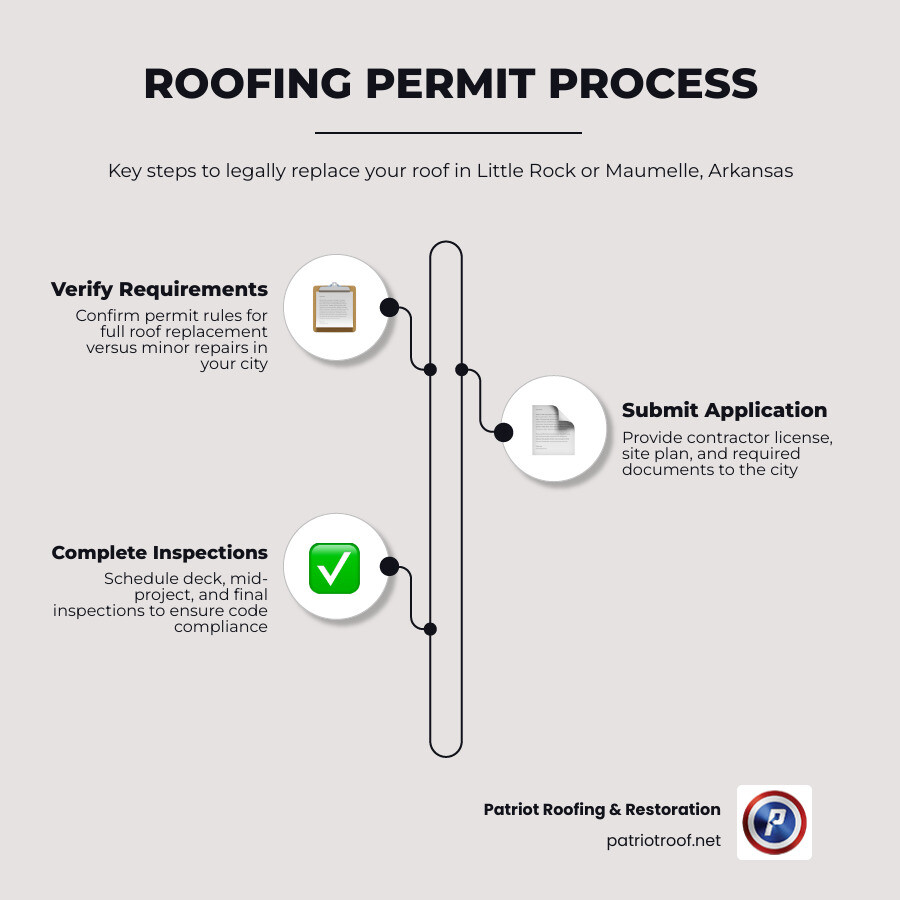
Applying for a roofing permit doesn’t have to be an overwhelming chore. If you are handling the application yourself, follow these step-by-step instructions to ensure a smooth process:
- Determine Your Jurisdiction: Confirm whether your property falls within the city limits of Little Rock or Maumelle, as this dictates which office you will submit your paperwork to.
- Gather Required Documentation: You will typically need to submit a completed building permit application, a basic site plan showing the home’s footprint, and proof of your contractor’s state licensing and insurance.
- Submit the Application: You can submit your application online through the respective city’s planning and development portal, or visit their building codes division in person.
- Pay the Plan Review and Permit Fees: Both cities require payment at the time of submission or upon initial approval.
- Wait for Approval: The city will review your plans to ensure they comply with local wind, fire, and ice-dam mitigation codes.
- Post the Permit: Once approved, you must print the permit and post it in a highly visible location on your property (like a front window) before any physical work begins.
Choosing the right materials is also an important part of this planning phase. For helpful advice on navigating local building trends and weather challenges, check out these Tips to Help Choose Best Roof Maumelle.
Who Pulls the Permit: Homeowner vs. Contractor
One of the most common questions we hear is: Should I pull the permit, or should my contractor do it?
While many cities allow a homeowner to pull an “owner-builder” permit for their primary residence, it is highly recommended that your roofing contractor pulls the permit.
When a contractor pulls the permit, they are legally recorded as the party responsible for the work. This means:
- They must prove they carry active general liability and workers’ compensation insurance.
- They are legally obligated to ensure all work meets local building codes.
- They are responsible for scheduling and passing all municipal inspections.
If you pull the permit yourself, you assume all liability for code compliance, safety violations, and any injuries that might occur on your property. Working with an insured professional ensures you enjoy all the Little Rock Local Roofing Company Benefits, including professional liability protection and experienced compliance management.
Required Inspections During and After Installation
A permit is only half the battle; the city also wants to make sure the work was actually done correctly. For a standard roof replacement, there are typically two main inspection phases:
- The Mid-Project / Deck Inspection: This takes place after the old shingles have been torn off but before the new shingles are nailed down. The inspector checks the exposed wooden decking for rot, verifies that the proper drip edge is installed, and ensures the ice-and-water shield is correctly placed in valleys and around penetrations.
- The Final Inspection: Once the roof is fully completed, the inspector will return to perform a final walkthrough. They will check for proper shingle nailing patterns, correct flashing around chimneys and dormers, and confirm that the attic ventilation system is balanced and meets code.
Ensuring your roof passes these rigorous checks is a key part of our Preparing Roof for Winter Maintenance Checklist Little Rock, protecting your home against harsh seasonal weather.
Risks of Replacing a Roof Without a Permit
It might be tempting to skip the permitting process to save a few dollars or bypass a multi-week waiting period. However, the consequences of unpermitted roof work in Central Arkansas can be severe:
- Stop-Work Orders: City code enforcement officers regularly patrol neighborhoods. If they spot a roofing crew working without a posted permit, they can shut down the job site immediately, leaving your home exposed to the elements.
- Double Fees and Fines: If you are caught working without a permit, both Little Rock and Maumelle can assess steep penalties, often doubling the original cost of the permit.
- Insurance Claim Denials: If your roof suffers storm damage in the future, your homeowner’s insurance company may deny your claim if they discover the roof was replaced without a permit and proper inspections.
- Real Estate Resale Roadblocks: When you sell your home, home inspectors and buyers’ agents will check municipal records. Unpermitted major renovations can stall a sale, force you to pay for retroactive permitting, or require you to tear off and replace the roof again to bring it up to code.
For a smooth recovery after severe weather, always ensure your contractor follows the proper legal channels. You can learn more about this in our guide on Steps to Take After Storm Damage Roof Little Rock.
Frequently Asked Questions About Central Arkansas Roofing Permits
How long does it take to get a roofing permit in Little Rock?
In Little Rock, the typical approval time for a residential roofing permit is about three weeks. This timeline allows the Department of Planning & Development to conduct a thorough plan review. However, simple re-roofing projects that do not involve structural modifications can sometimes be approved faster, especially if submitted by an established local contractor. Planning ahead is key, especially when preparing for seasonal weather shifts; see our Tips to Help Prepare Roof Summer Weather Maumelle to align your project timeline with the seasons.
Can a homeowner pull their own roofing permit in Maumelle?
Yes, under Maumelle’s local regulations, a homeowner can apply for an owner-builder permit to replace the roof on their primary residence. However, you must perform or directly supervise the work yourself and assume all legal and financial liability for code compliance and safety. If you are hiring a professional crew, it is always safer and more efficient to have the contractor pull the permit under their own license. If you’re weighing your options for a major upgrade, explore these New Year New Roof Reasons Maumelle Residents Replacing Roofs 2024 to see why professional installation makes a difference.
What is the average cost of a roof replacement in Little Rock in 2026?
The average cost of a roof replacement in Little Rock varies significantly based on several factors, including the square footage of your home (such as a standard 2,240 sq ft layout), the pitch and complexity of your roof line, and the quality of the materials you select. Asphalt shingles remain the most cost-effective and popular option, while premium materials like metal or tile represent a higher initial investment. Local labor rates and required municipal permit fees will also influence your final estimate.
Conclusion
Navigating the local building codes in Little Rock and Maumelle doesn’t have to be a headache. By understanding the rules, working with licensed professionals, and ensuring the proper permits are pulled, you can protect your home, your wallet, and your peace of mind.
At Patriot Roofing & Restoration, we believe in a quality-first approach. We serve homeowners across Central Arkansas—including Little Rock, Maumelle, North Little Rock, Sherwood, Jacksonville, Cabot, Bryant, and Benton—handling the entire permitting and inspection process from start to finish. Our work is backed by industry-leading warranties, Atlas certification, and our signature Patriot Shield Leak-Free Guarantee.
Ready to upgrade your home with a beautiful, fully compliant new roof?
Schedule your professional roof replacement with Patriot Roofing & Restoration today for a free, no-obligation consultation!